Co Loa Citadel: A Complete Guide to Vietnam’s Ancient Capital

Just beyond Hanoi’s bustling streets lies Co Loa Citadel, an ancient capital where history, legend, and archaeology come together. Once the heart of the Au Lac kingdom, this remarkable site invites you to wander through ancient ramparts, sacred temples, and stories of King An Duong Vuong, the magical crossbow, and Princess My Chau. If you’re looking to uncover a quieter, deeper side of Vietnam’s past, Co Loa is a journey well worth taking.
In this guide
What Is Co Loa Citadel and Why Is It Important?

Aerial view of Co Loa Citadel in Hanoi with ancient earth walls and moats
Co Loa Citadel is an ancient fortified settlement in present-day Dong Anh District, Hanoi. It is closely associated with the Au Lac state and King An Duong Vuong, traditionally dated to the third century BCE.
Unlike the stone castles that many international visitors may picture when they hear the word “citadel,” Co Loa was largely constructed using earth. Its sophisticated defensive system included ramparts, moats, waterways, and multiple fortified enclosures.
The scale and complexity of the site make it particularly significant.
Co Loa was more than a defensive structure. It functioned as a political center, military stronghold, settlement, and symbol of authority. Archaeological discoveries in and around the site have also provided valuable evidence about early Vietnamese society, craftsmanship, warfare, and settlement organization.
Today, Co Loa Citadel Hanoi remains both a historical destination and a living cultural landscape. Temples and communal buildings continue to serve local communities, while traditional ceremonies ensure that the stories associated with the ancient capital remain part of contemporary life.
Where Is Co Loa Citadel in Hanoi?
Co Loa is located in Dong Anh District, north of central Hanoi and across the Red River from much of the historic urban core.
Its location makes it particularly convenient for travelers who want to add an archaeological and cultural excursion to a Hanoi itinerary without traveling far from the city.
The change in atmosphere is noticeable.
Leave central Hanoi behind and the dense streets gradually give way to quieter residential areas and a more relaxed landscape. Once inside Co Loa, temples, ponds, village lanes, old trees, and surviving sections of earthen fortification create an environment that feels far removed from the traffic of the Old Quarter.
That contrast is part of the experience.
What Makes Co Loa Different From Other Ancient Citadels?
Co Loa is especially famous for its unusual defensive layout.
Rather than relying on a simple rectangular wall, the ancient settlement developed through multiple lines of fortification. The surviving landscape is traditionally described in terms of outer, middle, and inner defensive areas.
Its earthworks were combined with natural and artificial waterways, helping create a defensive network adapted to the geography of the Red River Delta.
This makes Co Loa ancient citadel interesting not only as a historical monument but also as an example of how early communities used engineering, landscape, and military planning together.
And then there are the legends.
Few archaeological sites in Vietnam have accumulated such a powerful combination of historical evidence and storytelling.
Co Loa Ancient Citadel Was the Capital of Which Ancient Kingdom?
One of the most common questions travelers ask is: Co Loa ancient citadel was the capital of which kingdom?
The answer is Au Lac, the ancient state traditionally associated with King An Duong Vuong.
The Capital of Au Lac Under King An Duong Vuong
According to Vietnamese historical tradition, An Duong Vuong established Au Lac after uniting groups associated with the Au Viet and Lac Viet peoples. He then chose Co Loa as his capital.
Building a major fortified center here represented an important development.
The citadel provided a seat of political power while its defensive system helped protect the kingdom. Its location within the fertile and strategically important Red River Delta also connected the capital to waterways, agricultural areas, and surrounding settlements.
For this reason, understanding Co Loa means looking beyond individual temples or archaeological objects. The wider landscape reflects an early attempt to organize political authority, defense, production, and settlement around a central capital.
From Ancient Capital to a Symbol of Vietnamese History
Co Loa did not disappear from history when the Au Lac period ended.
The area continued to have historical importance in later periods, and its association with early Vietnamese state formation gave it lasting symbolic value.
Over centuries, temples, communal traditions, festivals, and oral stories helped preserve memories of An Duong Vuong and his kingdom.
As a result, visitors encounter several layers of Co Loa at once.
There is the archaeological Co Loa reconstructed through excavations and artifacts. There is the historical Co Loa discussed in chronicles and scholarship. And there is the legendary Co Loa remembered through stories passed from one generation to another.
Together, they make the site unusually compelling.
The Legendary Story Behind Co Loa Ancient Citadel
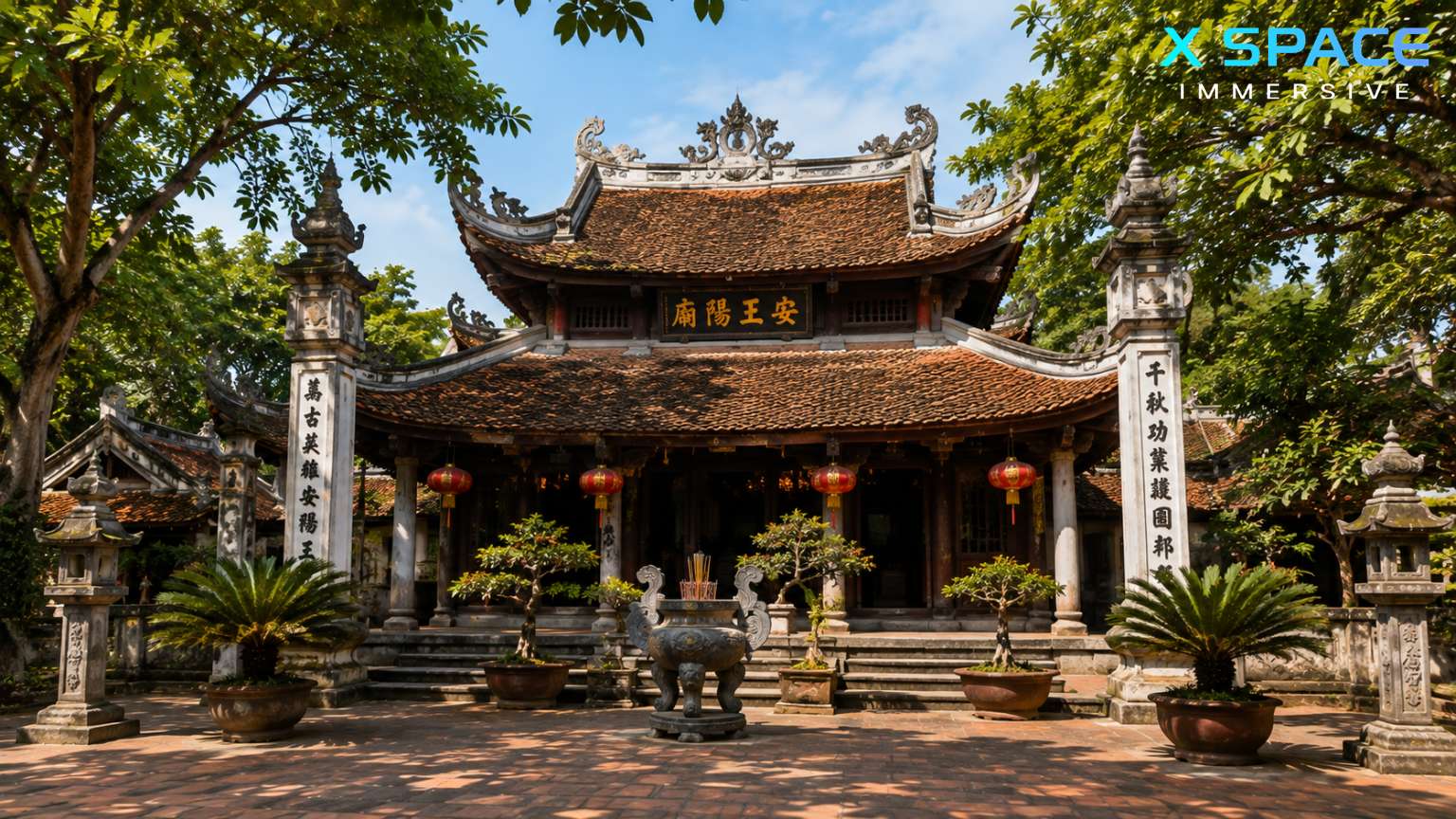
An Duong Vuong Temple at Co Loa Citadel associated with ancient Vietnamese legends
If archaeology gives Co Loa its physical evidence, legend gives it much of its emotional power.
The best-known stories surrounding the citadel involve a mysterious Golden Turtle, a magical crossbow, a king struggling to protect his kingdom, and a tragic love story that ends in betrayal and loss.
King An Duong Vuong and the Construction of Co Loa
According to legend, King An Duong Vuong repeatedly tried to build the citadel, only to see its walls collapse.
Something mysterious seemed to prevent the construction from succeeding.
Eventually, a supernatural Golden Turtle — often known as Kim Quy in Vietnamese tradition — appeared and helped the king overcome the forces interfering with the construction.
With this divine assistance, the citadel could finally be completed.
Before leaving, the Golden Turtle gave the king one of its claws. This would become connected to another legendary object: a powerful crossbow capable of protecting the kingdom from its enemies.
The story transformed Co Loa from a simple fortress into a sacred landscape where royal power, supernatural protection, and national destiny became intertwined.
The Magic Crossbow of Co Loa
The magical crossbow is perhaps the most famous object in the Co Loa legend.
Tradition describes a weapon made with the help of Cao Lo, an important figure associated with King An Duong Vuong. The turtle’s claw became part of the crossbow’s trigger mechanism, giving the weapon extraordinary power.
For generations, this story might have sounded purely mythical.
Yet archaeological discoveries at Co Loa have made the legend even more intriguing. Large numbers of bronze arrowheads and evidence associated with bronze production have been uncovered in the area.
Archaeology does not prove the existence of a supernatural weapon, of course. What it does reveal is that weapon production and military technology were genuinely important aspects of ancient Co Loa.
That meeting point between legend and archaeological evidence is one of the site’s most fascinating features.
The Tragic Legend of My Chau and Trong Thuy
The story eventually turns tragic.
According to the traditional narrative, Princess My Chau, daughter of An Duong Vuong, married Trong Thuy, the son of a rival ruler.
Through their relationship, the secret behind Co Loa’s magical crossbow was discovered. The weapon was compromised, leaving the kingdom vulnerable to attack.
When enemy forces advanced, An Duong Vuong fled with My Chau.
Only later did he realize that his daughter had unknowingly revealed their route and contributed to the kingdom’s downfall. The story ends in tragedy, with the loss of both family and kingdom.
For Vietnamese audiences, the legend has long carried meanings beyond romance. It raises questions about trust, loyalty, responsibility, vigilance, and the difficult relationship between private affection and obligations to a country.
Visiting Co Loa makes the story feel less distant. Names encountered in legends suddenly appear on temples and monuments, while the landscape gives physical form to stories many Vietnamese people have known since childhood.
Inside the Co Loa Citadel Archaeological Site
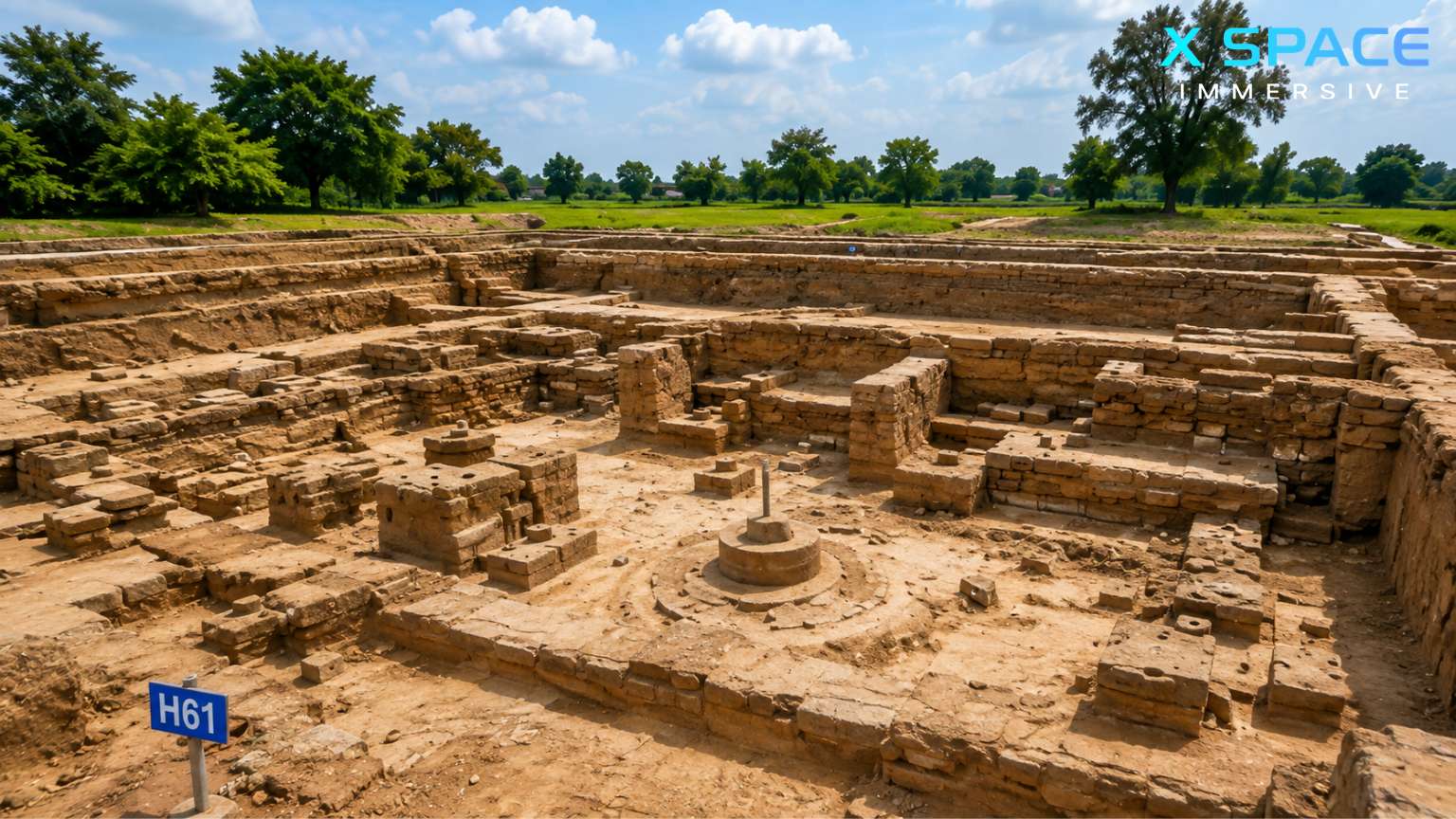
Archaeological excavation at Co Loa Citadel revealing traces of the ancient settlement
Beyond its legends, the Co Loa Citadel archaeological site is exceptionally important for understanding early Vietnamese history.
Archaeological research has revealed fortifications, artifacts, evidence of craft production, and traces of settlement that provide insight into the people who lived here more than two millennia ago.
The Unique Spiral-Shaped Citadel Structure
Co Loa is often associated with a spiral or shell-like shape.
The name itself is commonly linked with this distinctive form, although interpreting the exact layout of the ancient fortifications requires consideration of how the landscape and walls changed over many centuries.
Traditionally, visitors learn about three principal defensive zones: the Outer Citadel, Middle Citadel, and Inner Citadel.
These fortifications were built largely from compacted earth. Moats and waterways complemented the walls, creating additional defensive barriers while potentially supporting transportation and communication.
Imagine seeing this landscape when the ramparts were complete.
Instead of today’s quiet roads and village houses, enormous earthworks would have shaped movement through the capital. Waterways and defensive barriers would have controlled access, while the inner areas protected politically important spaces.
Even in fragmentary form, the scale hints at the organizational effort required to build such a complex site.
Archaeological Discoveries at Co Loa
Excavations have uncovered numerous artifacts associated with different phases of occupation.
Among the most famous finds are bronze arrowheads.
Their presence is particularly evocative because of Co Loa’s traditional association with the magical crossbow. Archaeologists have also found evidence related to bronze working and weapon production, helping researchers better understand the technological capabilities of communities living here.
Pottery, tools, architectural traces, and other materials add further pieces to the picture.
Rather than seeing ancient Co Loa only through kings and battles, these discoveries allow us to imagine everyday activity: craftspeople working with metal, communities producing pottery, people moving through fortified spaces, and generations adapting the settlement to changing circumstances.
What Archaeology Reveals About Ancient Vietnam
The importance of Co Loa extends far beyond the site itself.
Its archaeological evidence contributes to broader questions about social organization and technological development in early northern Vietnam.
Constructing extensive fortifications required planning, labor, knowledge of earthwork engineering, and the ability to coordinate large groups of people.
Bronze production reveals another level of technical expertise.
Together, these discoveries suggest a society capable of complex organization and specialized production.
This is why visiting Co Loa Citadel can be so rewarding. What initially looks like a peaceful collection of temples and village landscapes becomes much more meaningful once you understand what lies beneath and around them.
What to See at Co Loa Citadel Today
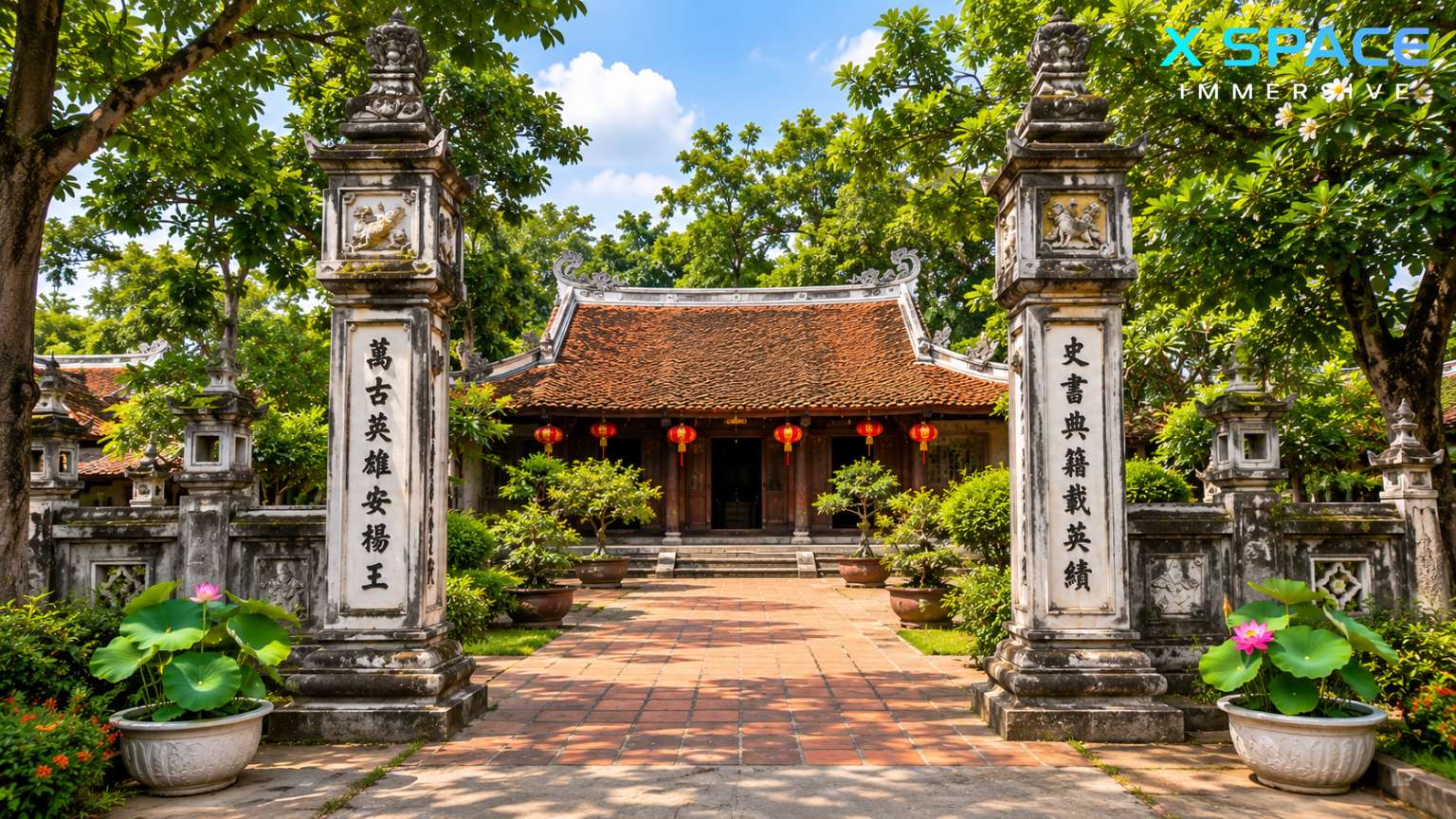
Traditional temple architecture and historic landmarks at Co Loa Citadel in Hanoi
Co Loa is not a destination where visitors simply walk through the ruins of a single monumental building.
Instead, the experience unfolds across a wider cultural landscape.
Temples, communal houses, ponds, village roads, archaeological remains, and traces of ancient ramparts are spread throughout the area.
An Duong Vuong Temple
One of the essential stops is the temple dedicated to King An Duong Vuong.
The complex provides a natural place to reflect on the ruler most closely associated with Co Loa and Au Lac.
Traditional architecture, courtyards, old trees, water, and ceremonial spaces create a calm atmosphere. Rather than rushing through, spend some time observing architectural details and how the temple fits into its surrounding landscape.
Remember that this is also a spiritual site.
Dress respectfully, keep your voice low around worship areas, and follow local guidance regarding photography.
Ngu Trieu Di Quy Communal House
Ngu Trieu Di Quy is another important landmark within Co Loa.
Traditional communal houses played central roles in village life, serving as places for ceremonies, meetings, and communal activities.
Its architecture offers visitors another perspective on Co Loa: this is not only an archaeological landscape frozen in the ancient past. It is also a community shaped by centuries of later Vietnamese cultural traditions.
My Chau Temple
The temple associated with Princess My Chau brings visitors back to the citadel’s most famous tragedy.
Knowing the story of My Chau and Trong Thuy before arriving makes this stop considerably more meaningful.
Instead of encountering the temple simply as another historic building, visitors can understand why My Chau remains such a complicated and memorable figure in Vietnamese cultural memory.
Cao Lo Temple
Cao Lo is traditionally remembered as an important military figure serving An Duong Vuong and is strongly associated with the legendary crossbow.
A visit provides an opportunity to explore another character in the Co Loa story while considering the relationship between legend and the archaeological evidence for bronze weapons discovered in the area.
Ancient Ramparts, Gates and Archaeological Remains
Do not focus only on the temples.
Some of Co Loa’s most important features are much less visually dramatic.
Sections of raised earth, changes in the landscape, ponds, waterways, and surviving fortification traces can easily be overlooked without understanding their significance.
Walking or cycling between landmarks is therefore one of the best ways to experience the site.
The slower pace allows you to appreciate Co Loa not as an isolated monument but as an entire historical landscape.
Co Loa Citadel Photos: The Best Places for Photography
Search for Co Loa Citadel photos, and you will quickly notice that this destination has a quieter visual character than many of Hanoi’s major landmarks.
That is precisely part of its charm.
You will not necessarily find one enormous monument that dominates every photograph. Instead, Co Loa rewards travelers who pay attention to details: temple roofs reflected in water, weathered gates, old trees, village paths, decorative carvings, and earthen ramparts softened by centuries of vegetation.
Best Photo Spots Around the Ancient Citadel
An Duong Vuong Temple is one of the most photogenic areas, particularly when traditional architecture, trees, and water can be composed within the same frame.
Ngu Trieu Di Quy offers attractive architectural details and a strong sense of traditional northern Vietnamese culture.
The surviving ramparts provide a completely different photographic opportunity. They may appear understated at first, but wider landscape compositions can communicate their scale and relationship with the surrounding settlement.
Village roads are worth photographing too.
Scenes of everyday life can often communicate the atmosphere of Co Loa more effectively than a conventional landmark photograph.
Best Time to Take Photos at Co Loa Citadel
Morning is an excellent time to explore.
Temperatures are generally more comfortable, the atmosphere can be quieter, and softer light works well with temple architecture and surrounding greenery.
Late afternoon can also produce attractive warm light.
If photography is a priority, avoid treating Co Loa as a quick midday stop. Giving yourself extra time allows you to wait for cleaner compositions and appreciate smaller details.
During the Co Loa Citadel Festival, the photographic experience changes completely. Ceremonies, processions, traditional clothing, decorations, and crowds bring energy and color to a landscape that is normally peaceful.
Co Loa Citadel Festival: A Celebration of Ancient Heritage
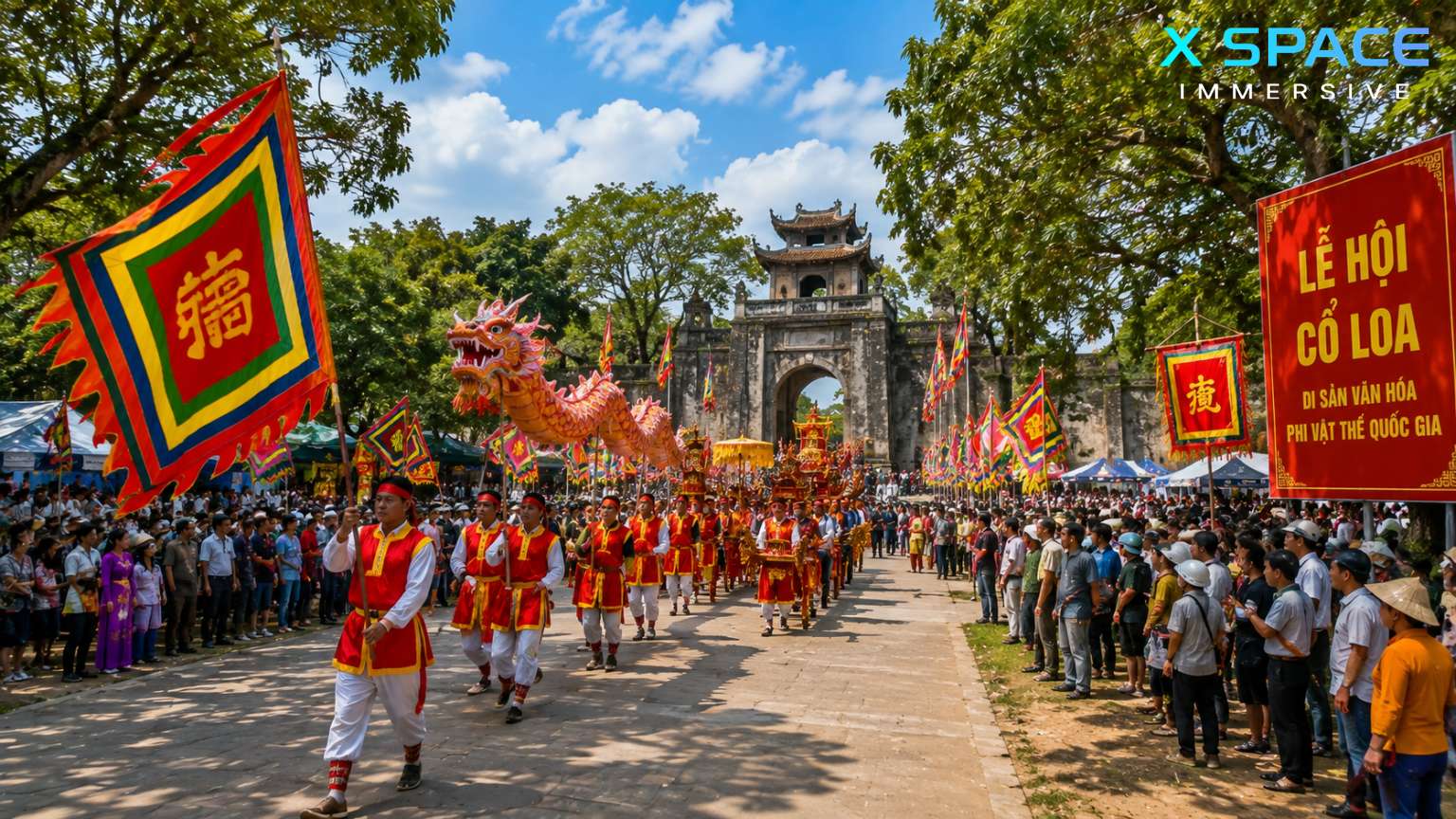
Co Loa Citadel Festival procession with traditional costumes, flags and cultural rituals
For travelers interested in living traditions rather than archaeology alone, the Co Loa Citadel Festival offers another way to experience the ancient capital.
The festival is associated with the commemoration of King An Duong Vuong and brings together ritual, community participation, historical memory, and traditional cultural activities.
When Is the Co Loa Citadel Festival Held?
The festival traditionally takes place around the sixth day of the first lunar month.
Because the Vietnamese lunar calendar does not correspond to the same Gregorian dates each year, international visitors should check the exact festival schedule before planning a trip specifically around the event.
Visiting during this period offers a very different experience from an ordinary day.
The normally tranquil heritage landscape becomes a gathering place filled with ceremonies and community activity.
Traditional Rituals and Processions
Ceremonial activities are among the festival’s central features.
Depending on the year’s program, visitors may encounter processions, offerings, worship ceremonies, and other traditional activities connected to the commemoration of An Duong Vuong.
These practices demonstrate something important about Co Loa.
The site is not simply an archaeological attraction maintained for tourists. It continues to occupy a meaningful place in the cultural and spiritual lives of local communities.
What Visitors Can Experience During the Festival
Festival time provides opportunities to observe traditions that are difficult to experience on an ordinary visit.
The atmosphere becomes more energetic, and visitors can see how historical memory is expressed collectively through ceremonies, gatherings, and folk activities.
However, remember that you are witnessing a cultural and spiritual event rather than a performance staged solely for visitors.
Be considerate when photographing ceremonies, avoid blocking processions, and follow instructions from local organizers.
Respect will make the experience better for everyone.
How to Visit Co Loa Citadel From Hanoi
One of the advantages of visiting Co Loa Citadel Hanoi is accessibility.
You can experience a site associated with some of Vietnam’s earliest political history without committing to a long journey away from Hanoi.
How to Get to Co Loa Citadel
From central Hanoi, Co Loa can generally be reached by car, taxi, ride-hailing service, motorbike, or public transportation.
A private car or taxi is usually the easiest choice for international travelers who value convenience.
Public buses can be more economical, although routes and connections may require additional planning.
Travel times vary considerably depending on your starting point and Hanoi traffic, so allow extra time rather than planning a tightly scheduled journey.
Opening Hours and Entrance Information
Opening hours, ticket policies, restoration work, and access arrangements can change.
For that reason, check current information from reliable local or official sources shortly before visiting rather than relying entirely on older travel articles.
Arriving earlier in the day is generally a good strategy.
You will have more time to explore the different monuments and landscape features without feeling rushed.
How Much Time Do You Need at Co Loa?
For a quick overview, around two hours may be sufficient to visit several key landmarks.
However, a half-day trip is a much better option for travelers genuinely interested in Vietnamese history and culture.
Co Loa is best appreciated slowly.
Give yourself time to walk between temples, look at the landscape, read available historical information, and notice traces of the fortifications.
If you enjoy archaeology or photography, you may want even longer.
Tips for First-Time Visitors
Wear comfortable walking shoes because the site covers a wider area than a single temple complex.
Bring drinking water during warmer months and consider sun protection, especially around midday.
Because several landmarks are active religious spaces, modest clothing is recommended. Observe local customs, avoid touching sacred objects, and ask before photographing people at close range.
Most importantly, learn the basic story of An Duong Vuong, My Chau, Trong Thuy, Cao Lo, and the magical crossbow before you arrive.
Knowing the story transforms the visit.
A pond is no longer simply a pond. A temple becomes connected to a character. Bronze arrowheads suddenly carry a different significance.
Context is what makes Co Loa come alive.
Suggested Half-Day Co Loa Citadel Itinerary
You do not need an entire day to enjoy Co Loa, but you should avoid rushing.
A relaxed half-day itinerary provides a good balance.
Morning: Explore the Ancient Capital
Start early from central Hanoi to avoid some of the heat and traffic.
Once you arrive, begin by orienting yourself within the wider citadel landscape rather than immediately moving from temple to temple.
Explore the surviving fortification areas and consider how dramatically the landscape would have looked when the walls and moats were functioning as a defensive system.
Continue to An Duong Vuong Temple, then visit Ngu Trieu Di Quy and the sites associated with My Chau and Cao Lo.
If archaeological displays are accessible during your visit, give them time. Seeing artifacts after walking through the landscape helps connect the stories to physical evidence.
Midday: Discover Local Culture
Before returning to Hanoi, slow down and observe the contemporary community around the ancient capital.
Co Loa remains a lived-in environment rather than an isolated archaeological park.
This relationship between heritage and everyday life is easy to miss if you only move between major monuments.
If suitable local dining options are available, lunch in the area can extend the experience before your return journey.
Afternoon: Return to Central Hanoi
After exploring a capital from more than two thousand years ago, returning to modern Hanoi creates an interesting contrast.
You can continue the historical theme with museums and heritage sites in the city or move into a more contemporary cultural experience.
The combination works particularly well because Vietnamese history is not represented by a single period. Hanoi and its surroundings contain layers ranging from ancient settlements to imperial heritage, colonial architecture, revolutionary history, and modern digital storytelling.
Co Loa Citadel FAQs
Is Co Loa Citadel Worth Visiting?
Yes, particularly if you are interested in Vietnamese history, archaeology, legends, traditional architecture, or destinations beyond Hanoi’s busiest tourist attractions.
Co Loa is less about spectacular ruins and more about understanding a historical landscape.
Travelers willing to engage with its stories often find the experience highly rewarding.
How Old Is Co Loa Citadel?
Co Loa is generally associated with the period of the Au Lac state and King An Duong Vuong in the third century BCE, although archaeological research at the broader site provides evidence relating to different phases of human occupation.
This makes it one of the most significant ancient settlement and fortification sites in northern Vietnam.
Who Built Co Loa Ancient Citadel?
Vietnamese historical tradition closely associates the construction of Co Loa with King An Duong Vuong, ruler of Au Lac.
Legends surrounding its construction also feature the Golden Turtle, whose supernatural assistance supposedly helped the king successfully complete the fortress.
What Was Co Loa Ancient Citadel the Capital Of?
Co Loa ancient citadel was the capital of Au Lac, the ancient kingdom traditionally ruled by An Duong Vuong.
This role is one of the main reasons the site occupies such an important position in narratives about early Vietnamese history.
How Far Is Co Loa Citadel From Central Hanoi?
Co Loa lies in Dong Anh District, north of central Hanoi.
The exact travel distance and journey time depend on where you start and current traffic conditions. For most visitors staying around central Hanoi, it is practical as a half-day excursion.
What Is the Best Time to Visit Co Loa Citadel?
Morning is generally the most comfortable time, particularly during warmer months.
Travelers who prefer quieter exploration may want to visit on a normal weekday, while those interested in traditional ceremonies can consider planning around the annual Co Loa Citadel Festival.
Weather in Hanoi changes considerably throughout the year, so checking the forecast shortly before your trip is always worthwhile.
Experience X Space Immersive: Step Into Vietnam’s History
Walking through Co Loa Citadel allows you to stand where layers of Vietnamese history have accumulated for more than two millennia.
You can follow traces of ancient fortifications, visit temples associated with legendary figures, look at archaeological discoveries, and imagine how this landscape may once have functioned as the heart of an ancient kingdom.
But sometimes, seeing where history happened leaves you wanting something more.
What did these stories feel like when they were unfolding?
What if history could move beyond artifacts, dates, and written descriptions and become an experience surrounding you?
That is where a different kind of cultural journey can begin.
Continue Your Journey From Ancient Ruins to Immersive History
At Co Loa, much of the experience depends on imagination.
The ancient walls have changed. Buildings have disappeared. The people whose decisions shaped the kingdom are known through archaeological evidence, historical traditions, and legends.
Modern immersive technology offers another way of approaching the past.
Instead of simply looking at historical information, immersive storytelling can use space, imagery, sound, movement, and digital technology to place audiences closer to the atmosphere of a story.
For travelers who have spent the morning exploring an archaeological landscape, this creates an interesting contrast.
At Co Loa, you search for traces of history.
In an immersive environment, history can be interpreted around you.
Discover Vietnamese Heritage Through Experience X Space Immersive

Visitors enjoying the X Space Immersive experience in Hanoi
Experience X Space Immersive offers travelers another perspective on discovering Vietnamese culture through immersive storytelling and technology.
Rather than replacing museums, monuments, or archaeological sites, experiences of this kind can complement them.
Physical heritage gives you authenticity — the opportunity to stand in a real place connected to events and communities of the past.
Immersive storytelling can add emotion, movement, atmosphere, and visual interpretation.
Together, the two approaches can help international visitors move beyond simply asking, “What happened?” toward a more engaging question:
“What might it have felt like to be there?”
That shift can make cultural discovery more personal.
And after spending time at Co Loa ancient citadel, where archaeology and legend already exist side by side, an immersive experience feels like a natural continuation of the journey.
Make Experience X Space Immersive Your Next Cultural Experience in Hanoi
Co Loa reminds us that history does not survive in only one form.
Sometimes it survives beneath the ground as an archaeological artifact.
Sometimes it remains in an ancient rampart covered with grass.
Sometimes it is protected inside a temple, repeated during a festival, or remembered through a story parents tell their children.
And sometimes, technology gives those stories a new way to be experienced.
If Co Loa Citadel introduces you to the foundations of Vietnam’s ancient past, Experience X Space Immersive can be the next step in exploring how Vietnamese stories and cultural heritage can be brought closer to modern audiences.
Visit the ancient capital. Walk along landscapes shaped by more than two thousand years of history. Discover the stories of An Duong Vuong, My Chau, Trong Thuy, Cao Lo, and the legendary crossbow.
Then continue the journey beyond the archaeological site.
Step into the story with Experience X Space Immersive — and experience Vietnamese history from a new perspective.
Was this article helpful?
Thanks for your feedback!