Van Phuc Silk Village: Discover Hanoi’s Timeless Silk Heritage

Van Phuc Silk Village is where Hanoi’s timeless silk heritage comes to life through colorful fabrics, rhythmic looms, and generations of skilled craftsmanship. Beyond a place to shop for beautiful silk, this historic village invites you to wander its charming streets, meet local artisans, and discover the stories woven into one of Vietnam’s most treasured traditional crafts.
In this guide
Van Phuc Silk Village – A Living Legacy of Vietnamese Silk
Located in Van Phuc Ward in the Ha Dong area of Hanoi, Van Phuc Silk Village is closely associated with Vietnam’s long tradition of silk weaving.
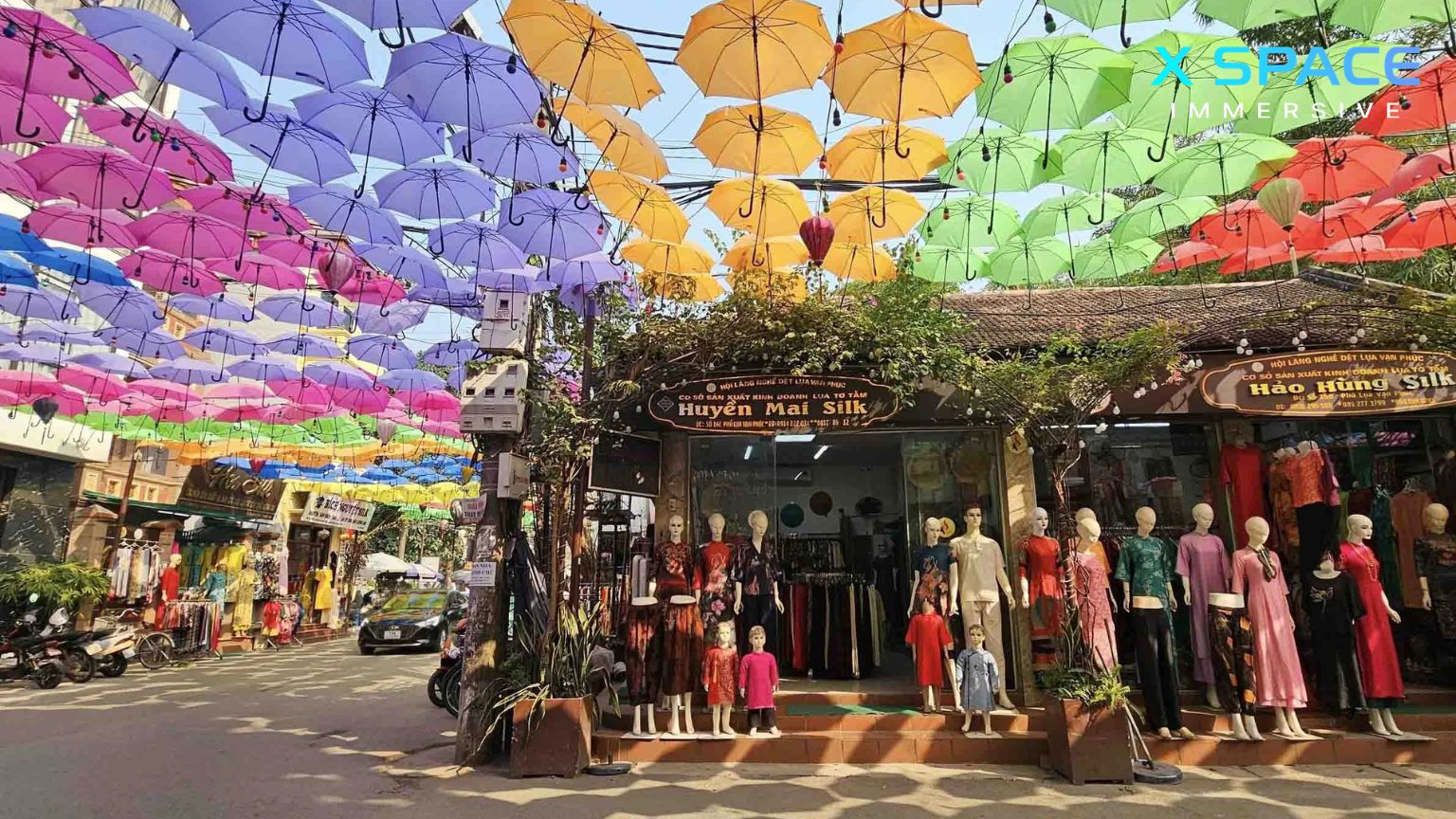
Traditional silk weaving artisan at Van Phuc Silk Village Vietnam
Unlike a museum where historic objects are displayed behind glass, Van Phuc is a living community. People live, work, shop, and continue practicing traditional crafts here. That everyday quality is part of what makes the village interesting.
As you enter the village, the atmosphere gradually changes. Silk stores line the streets, fabrics appear in an impressive spectrum of colors, and decorative elements celebrate the area’s weaving heritage. Behind the storefronts, the story becomes even more compelling: generations of knowledge lie behind the finished pieces visitors see today.
For travelers, Van Phuc Silk Village Vietnam provides a chance to connect an everyday product – silk – with the people, skills, and traditions behind it.
Instead of simply buying a scarf, you can begin to understand the craftsmanship that gives it meaning.
And that is perhaps the best reason to visit.
The History of Van Phuc Silk Village Vietnam
From an Ancient Craft Village to a Vietnamese Silk Icon
The identity of Van Phuc has been intertwined with silk weaving for centuries.
Over generations, local families developed and passed down knowledge related to weaving techniques, patterns, fabric handling, and production. Skills were traditionally learned through observation and practice, moving from experienced craftspeople to younger family members.
This continuity helped establish Van Phuc as one of Vietnam’s recognizable silk-making communities.
What makes its history especially meaningful is that the craft did not simply remain part of the past. It adapted.
Traditional techniques have continued while designs, products, and production methods have evolved to respond to changing lifestyles and markets. Today, visitors can find both fabrics that evoke classic Vietnamese aesthetics and contemporary scarves, dresses, accessories, and decorative items.
That balance between preservation and adaptation gives Van Phuc Silk Village much of its character.
It is not frozen in history.
It is a heritage that continues to move.
The Cultural Legacy Behind Van Phuc Silk
Silk has long held an important place in Vietnamese clothing and cultural expression.
Its softness, lightness, and elegant appearance have made it especially suited to traditional garments, including the áo dài. Silk fabrics also appear in scarves, formal clothing, decorative objects, and gifts associated with Vietnamese craftsmanship.
Yet the cultural value of Van Phuc silk goes beyond the material itself.
Every woven piece represents a combination of knowledge and patience. Selecting threads, preparing a loom, controlling tension, creating patterns, and completing a piece of fabric all require attention to detail.
When these skills are preserved over generations, craftsmanship becomes a form of cultural memory.
Visiting Van Phuc Silk Village Vietnam, therefore, is not simply about seeing where silk is sold. It offers an opportunity to appreciate the human knowledge behind an enduring Vietnamese craft.
What Makes Van Phuc Silk Village Hanoi Worth Visiting?
Hanoi has no shortage of attractions, so travelers with limited time naturally ask: is Van Phuc Silk Village worth visiting?
For visitors interested in traditional crafts, local culture, photography, textiles, or shopping, it certainly deserves consideration.
Walk Through a Centuries-Old Craft Village
One of the pleasures of visiting Van Phuc Silk Village Hanoi is simply walking.
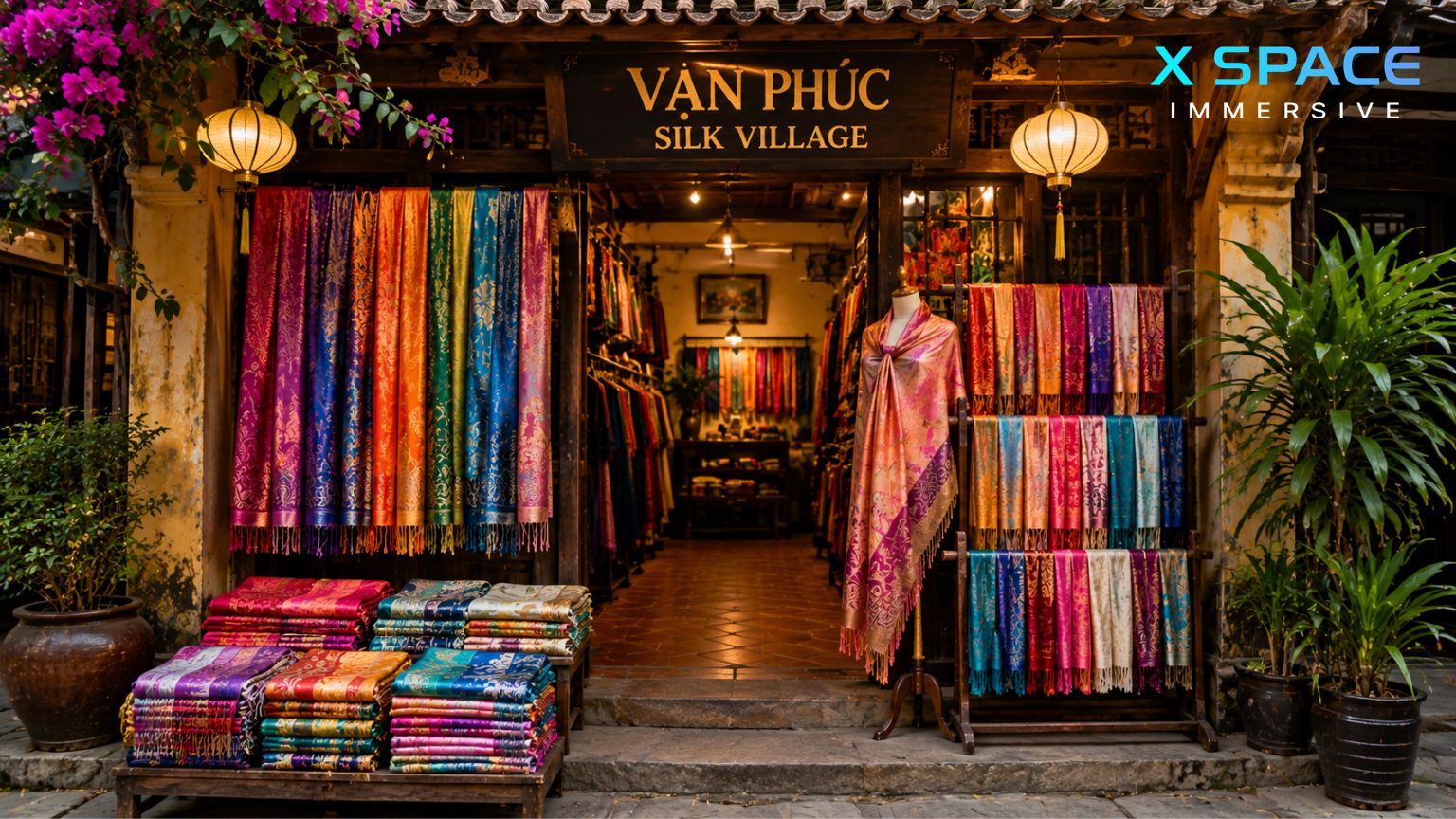
Colorful traditional silk shop at Van Phuc Silk Village Hanoi
You do not need to rush from one attraction to another. Instead, allow yourself to explore slowly.
Wander along streets lined with silk shops. Notice the colors and patterns displayed outside family businesses. Look beyond the main commercial areas into quieter corners of the neighborhood.
The experience is different from central Hanoi.
Although Van Phuc has become a popular destination and shopping area, traces of its craft-village identity remain visible throughout the community. The combination of traditional heritage and everyday urban life makes it particularly interesting for travelers who enjoy discovering places through observation rather than ticking landmarks off a list.
Watch Traditional Silk Weaving Up Close
A finished piece of silk feels effortless—smooth, delicate, and light.
Making it is anything but effortless.
Where demonstrations or working looms are accessible, watching the weaving process can transform your understanding of the material. The repetition, precision, and coordination required to turn individual threads into patterned fabric reveal just how much skill lies behind something that may look simple in a shop.
Listen closely and you may hear the distinctive mechanical rhythm of the loom.
Watch the threads move.
Notice how patterns emerge gradually.
These moments make a visit to Van Phuc Silk Village more meaningful because they connect the product with its process.
Meet Local Artisans and Discover Their Stories
Buildings and fabrics are visually appealing, but people are what keep a craft alive.
When the opportunity arises, speaking with shop owners or craftspeople can add another dimension to your visit. Ask about the types of silk they sell, how different fabrics are produced, which patterns are traditional, or how their family became involved in the craft.
Not every visit will involve a long conversation with an artisan, of course. Van Phuc is a working community rather than a staged cultural attraction.
But even short exchanges can provide valuable insight.
They remind visitors that heritage is not an abstract idea—it survives because people continue to practice, adapt, teach, and value it.
Best Things to Do at Van Phuc Silk Village
A visit can be as relaxed or as detailed as you want. You might spend a couple of hours browsing and taking photographs, or devote half a day to learning about silk, shopping, and exploring the surrounding streets.
Here are some experiences worth making time for.
Explore the Colorful Silk Street
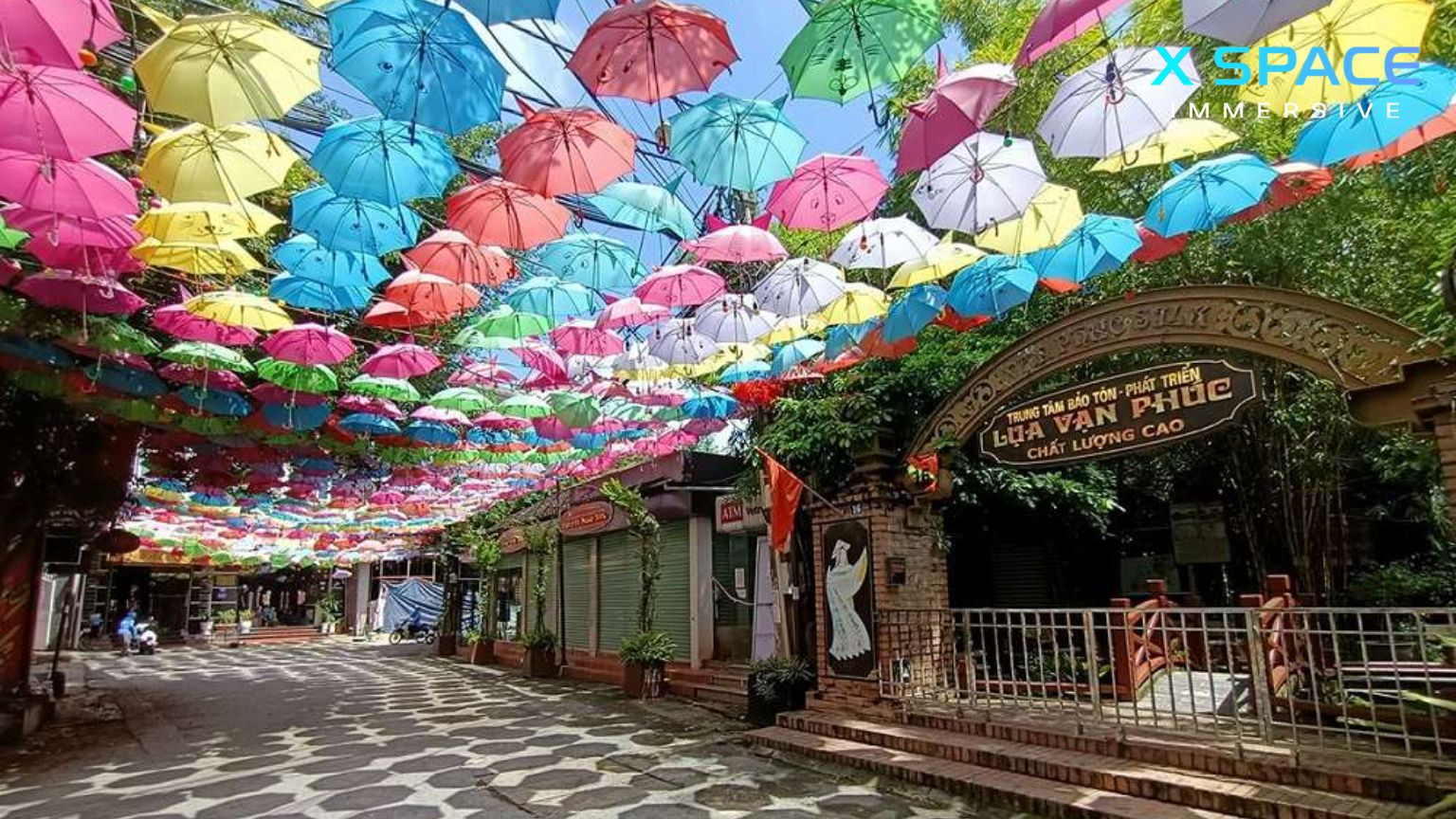
Charming street at Van Phuc Silk Village with colorful silk and lanterns
Start by walking through the village’s main commercial area.
The visual experience is immediately appealing: scarves, fabrics, clothing, and decorative textiles bring color to storefronts, while village-themed decorations create plenty of opportunities for photography.
But resist the temptation to move too quickly.
Step inside different shops and compare fabrics. Look at how patterns vary. Feel different textures when invited to do so. You will quickly discover that “silk” encompasses a much wider range of appearances and products than you might expect.
Exploring before buying also gives you a better sense of prices, styles, and quality.
Discover How Vietnamese Silk Is Made
Understanding the process helps you appreciate the finished fabric.
Silk production involves multiple stages before material is ready to become clothing or accessories. Traditional weaving itself requires careful preparation of threads and precise control of the loom to create consistent fabric and patterns.
For visitors, the most memorable part is often seeing weaving in action.
A pattern that appears perfectly formed on a finished scarf looks very different when you watch it emerge thread by thread.
This contrast between slow craftsmanship and effortless beauty is one of the most fascinating aspects of Van Phuc Silk Village.
If you join a guided Van Phuc Silk Village tour, ask whether the itinerary includes a weaving demonstration or an opportunity to learn about the production process rather than focusing exclusively on shopping.
Shop for Authentic Van Phuc Silk
Shopping is naturally a major part of the Van Phuc experience.
Stores sell a broad range of textile products, including silk scarves, fabric for tailoring, clothing, ties, accessories, decorative pieces, and materials suitable for making an áo dài.
A silk scarf can be an especially practical souvenir: it is lightweight, easy to pack, distinctly connected to the village, and useful long after your trip ends.
If you are interested in clothing, take your time.
Ask what material the item is made from, where it was produced, and whether the seller can explain its characteristics. Comparing several shops before purchasing is perfectly reasonable.
The goal does not have to be finding the cheapest item.
A more rewarding approach is to find something you genuinely enjoy while understanding what you are buying and who you are buying it from.
Capture the Best Photo Spots
Van Phuc can be particularly enjoyable for photographers.
Colorful fabrics, decorative streets, shopfronts, weaving equipment, and everyday village scenes provide a wide variety of subjects.
For more natural photographs, look beyond the obvious photo installations.
Details often tell a stronger story: hands working near a loom, layers of folded fabric, sunlight falling across silk, an old doorway beside a modern store, or colorful threads waiting to be woven.
Morning light can be pleasant for walking and photography, while arriving earlier may also give you a quieter experience.
Always ask permission before taking close-up photographs of craftspeople or inside private workspaces.
How to Identify Authentic Van Phuc Silk
One challenge visitors sometimes face is understanding exactly what they are buying.
The commercial area offers products at different prices and quality levels, so it is worth approaching silk shopping with curiosity rather than assumptions.
Look at the Texture and Natural Shine
Silk is known for its smooth texture and distinctive appearance, but evaluating a fabric based on one characteristic alone can be misleading.
Rather than relying on a single “trick,” examine the overall quality.
Look at the surface of the fabric under different angles of light. Feel the texture if the seller permits it. Compare several products side by side.
High-quality material should generally feel pleasant and well finished, but different weaving styles can create different textures.
This is why asking questions is often more useful than trying to perform a quick authenticity test yourself.
Check the Weaving and Craftsmanship
Pay attention to construction.
Look closely at patterns, edges, stitching on finished products, and the consistency of the fabric. If you are purchasing clothing or accessories, examine the overall workmanship rather than judging the textile alone.
You can also ask the seller to explain how a particular piece was produced.
A knowledgeable seller should usually be able to tell you something meaningful about the material, design, or weaving process.
Smart Tips Before Buying Silk
Do not feel pressured to purchase from the first shop you enter.
Browse several stores first and develop a sense of what is available. Ask about materials and prices. If you are buying fabric for tailoring, confirm dimensions and consider how much material your intended garment will require.
Most importantly, avoid assuming that every textile product sold within a famous silk village must be identical in origin, composition, or quality.
Shop thoughtfully.
The best souvenir is one whose story and quality you understand.
Van Phuc Silk Village Tour – How to Plan Your Visit
Van Phuc is close enough to central Hanoi to work well as a half-day excursion.
You can explore independently or arrange a Van Phuc Silk Village tour, depending on how deeply you want to understand the craft.
Best Time to Visit Van Phuc Silk Village
Daytime is generally the most practical period for visiting because shops and craft-related activities are more likely to be active.
If you enjoy photography and quieter streets, consider arriving in the morning. This also leaves plenty of time to browse without feeling rushed.
Allow at least a couple of hours for a casual visit.
For travelers who want to shop carefully, observe weaving, take photographs, and explore beyond the main street, a half-day schedule is more comfortable.
Self-Guided Visit vs. Van Phuc Silk Village Tour
A self-guided trip offers flexibility.
You can stay longer in shops you find interesting, stop for photographs whenever you like, and explore at your own pace. This option suits independent travelers who primarily want to wander, shop, and enjoy the atmosphere.
A guided Van Phuc Silk Village tour, on the other hand, can provide greater cultural context.
A knowledgeable guide may help explain the history of the village, weaving techniques, traditional patterns, and the role of silk in Vietnamese culture. Guided visits can also make conversations with craftspeople easier when language is a barrier.
Neither option is inherently better.
Choose based on what you want from the experience: freedom or deeper interpretation.
Suggested Half-Day Van Phuc Silk Village Itinerary
A relaxed half-day visit might begin with a walk through the village entrance and main streets. Spend the first part of your trip getting oriented rather than shopping immediately.
Next, look for an opportunity to learn about silk weaving. Take time to observe the process and understand how threads become finished fabric.
Continue exploring local stores, comparing designs and products before choosing any souvenirs.
Leave time for photography and quieter side streets rather than staying exclusively in the busiest shopping area.
A simple itinerary could look like this:
Arrival → village walk → silk-weaving discovery → local interaction → shopping → photography → departure.
Keeping the schedule flexible allows spontaneous moments—which are often the most memorable part of visiting a traditional craft community.
Van Phuc Silk Village Map – How to Get There from Hanoi
Planning transportation in advance makes the experience easier, particularly for first-time visitors.
Before leaving your hotel, save a Van Phuc Silk Village map or pin the destination in your preferred navigation app.
Where Is Van Phuc Silk Village Hanoi?
Van Phuc Silk Village Hanoi is located in the Ha Dong area, southwest of Hanoi’s historic center.
Travel time depends heavily on your starting point and traffic conditions, so avoid planning your journey too tightly.
Using a current digital Van Phuc Silk Village map is the easiest way to check the most convenient route on the day of your visit.
Getting There by Taxi or Ride-Hailing App
For international visitors, a taxi or ride-hailing service is often the simplest option.
Enter Van Phuc Silk Village as your destination and check the location before confirming the ride. Having the destination saved on your phone can also help if communication with the driver is difficult.
For the return journey, choose a convenient pickup point on a larger street where your driver can easily reach you.
Getting There by Bus or Private Transport
Public transportation can be an economical option for travelers comfortable navigating Hanoi’s bus system.
Routes and schedules may change, so check a current transportation app before departure rather than relying on older travel blogs.
Travelers with private transportation have greater flexibility, but Hanoi traffic can be challenging if you are unfamiliar with local road conditions.
For most first-time international visitors, arranging a car, taxi, or ride-hailing service is likely to be the most straightforward solution.
Essential Navigation Tips for First-Time Visitors
Save the destination offline or take a screenshot of your Van Phuc Silk Village map before leaving.
Keep your accommodation address saved as well.
When you arrive, note a recognizable landmark near your drop-off location. This can make finding your pickup point easier later.
And give yourself extra travel time, particularly if you need to return to central Hanoi for another scheduled activity.
Essential Tips Before Visiting Van Phuc Silk Village Vietnam
A little preparation can make your visit considerably more enjoyable.
Wear comfortable shoes because exploring the village is best done on foot. Lightweight clothing is useful during Hanoi’s warmer and more humid months, while sun protection and drinking water can make daytime exploration more comfortable.
Carry a payment option that works for smaller purchases. Payment methods can vary between businesses, so having some Vietnamese dong available may be convenient.
When shopping, be curious and respectful. Asking questions about materials, production, and craftsmanship can lead to more meaningful interactions than immediately negotiating over price.
If you photograph people, especially at close range, ask first.
Remember that Van Phuc Silk Village Vietnam is not merely a tourist attraction. It is a living neighborhood and workplace.
Treating workshops, homes, craftspeople, and local traditions with respect makes the experience better for everyone.
Most importantly, slow down.
Van Phuc is not a destination that needs to be “completed.”
Its charm lies in noticing the details.
Van Phuc Silk Village FAQs
Is Van Phuc Silk Village Worth Visiting?
Yes, particularly if you are interested in Vietnamese culture, traditional crafts, textiles, photography, or locally connected souvenirs.
It offers a different experience from Hanoi’s major temples, museums, and Old Quarter attractions. Rather than visiting a single monument, you explore a community shaped by a craft tradition.
Travelers primarily interested in nightlife or major historical landmarks may consider it optional, but for culture-focused visitors, Van Phuc Silk Village can be a rewarding half-day trip.
Is Van Phuc Silk Village Free to Visit?
You can generally explore the public streets and shopping areas of the village without treating the destination like a conventional ticketed attraction.
However, individual experiences, guided tours, workshops, exhibitions, or other activities may have separate charges.
Check current information for any specific experience you plan to join.
How Long Should You Spend at Van Phuc Silk Village?
Around two to four hours works well for many visitors.
A shorter visit is enough for walking and shopping, while a half day gives you more time to observe weaving, take photographs, compare products, and explore at a relaxed pace.
If you book a Van Phuc Silk Village tour, follow the duration provided by the operator and consider leaving additional free time afterward for shopping.
What Should You Buy at Van Phuc Silk Village?
Silk scarves are among the easiest souvenirs to carry home.
You can also consider fabric for tailoring, clothing, accessories, ties, decorative textiles, or material for a traditional Vietnamese áo dài.
Instead of choosing purely by price, consider craftsmanship, material, design, and whether the piece has a meaningful connection to your visit.
How Far Is Van Phuc Silk Village from Central Hanoi?
Van Phuc is located in the Ha Dong area, southwest of Hanoi’s central tourist districts.
Exact travel distance and time depend on your starting location, route, and traffic. Check a live Van Phuc Silk Village map shortly before departure for the most useful estimate.
Can You Visit Van Phuc Silk Village Without a Tour?
Absolutely.
Independent travelers can walk around the village, browse shops, take photographs, and explore at their own pace.
A guided Van Phuc Silk Village tour becomes particularly valuable when you want detailed explanations of weaving techniques, history, patterns, and local culture.
Beyond Van Phuc Silk Village: Experience X Space Immersive
A morning at Van Phuc Silk Village introduces you to a Hanoi shaped by threads, looms, craftsmanship, and traditions passed from one generation to the next.
But Hanoi does not tell its stories in only one way.
After experiencing the tactile world of silk and traditional craftsmanship, you can continue your cultural journey through an entirely different medium at Experience X Space Immersive.

Visitors enjoying the X Space Immersive experience in Hanoi
The transition creates an intriguing contrast.
At Van Phuc, heritage can be touched: you feel fabric between your fingers, hear the rhythm of weaving, and watch craftspeople transform threads into patterns.
An immersive space approaches storytelling from another direction, using contemporary forms of visual, spatial, sensory, and technological expression to invite visitors into an experience rather than asking them to simply observe it.
Together, these two perspectives reveal something compelling about Hanoi.
The city is deeply connected to its past, yet it continually discovers new ways to interpret culture, creativity, and human stories.
Step from Traditional Heritage into an Immersive World
Think of the journey as moving between two languages of storytelling.
Van Phuc Silk Village Hanoi speaks through craftsmanship.
Its vocabulary consists of silk threads, patterns, textures, wooden looms, practiced movements, and knowledge carried across generations.
Experience X Space Immersive represents a more contemporary language—one where space itself can become part of the story and visitors can move beyond passive observation toward a more sensory experience.
The two do not need to compete.
In fact, experiencing them within the same Hanoi journey can make both more interesting.
Traditional craftsmanship helps us understand where cultural stories come from. Immersive experiences can encourage us to think about how those stories might be felt, interpreted, and shared today.
It is the difference between looking at culture and stepping into it.
Make Experience X Space Immersive Your Next Hanoi Stop
Hanoi rewards travelers who look beyond the obvious.
Its identity is not confined to a single historic district, temple, craft, or period. It exists in the conversations between old and new: ancient streets and contemporary creativity, handmade traditions and digital expression, quiet workshops and immersive environments.
Begin at Van Phuc Silk Village, where generations of craftsmanship reveal how patience and skill can turn individual threads into something enduring.
Then allow your journey to evolve.
Step from the tactile beauty of Vietnamese silk into a contemporary world of experiential storytelling at Experience X Space Immersive.
Because discovering Hanoi is not only about seeing where the city has been.
Sometimes, the most memorable journey comes from experiencing how its stories can be told in entirely new ways.
Discover Experience X Space Immersive and add a new dimension to your Hanoi cultural journey.
Was this article helpful?
Thanks for your feedback!