Old City Gate Hanoi: Discover a Historic Icon of the Old Quarter

In a city where the past seems to linger around every corner, Old City Gate Hanoi stands quietly between busy streets, local shops, motorbikes, and the everyday rhythm of the Old Quarter. It may not be as grand as Hanoi’s temples or as immediately recognizable as Hoan Kiem Lake, but this centuries-old gateway tells one of the most compelling stories of the capital.
Known locally as O Quan Chuong Gate (Ô Quan Chưởng), the structure is the only surviving ancient city gate of its kind in Hanoi today. First built in 1749, it once formed part of the system of gateways connecting old Thang Long with surrounding areas. Centuries later, people still pass beneath its arches as part of their daily lives—a rare scene where a historical monument remains woven into the living city rather than separated from it.
For travelers exploring the Hanoi Old Quarter, the gate offers more than a quick photo stop. Its weathered walls, traditional architecture and location near some of the neighborhood’s most atmospheric streets provide a window into a Hanoi that existed long before modern boulevards and high-rise buildings transformed the capital.
Here is everything you need to know before visiting Old City Gate Hanoi, from its history and architecture to nearby attractions and a suggested walking route through the Old Quarter.
In this guide
What Is Old City Gate Hanoi?
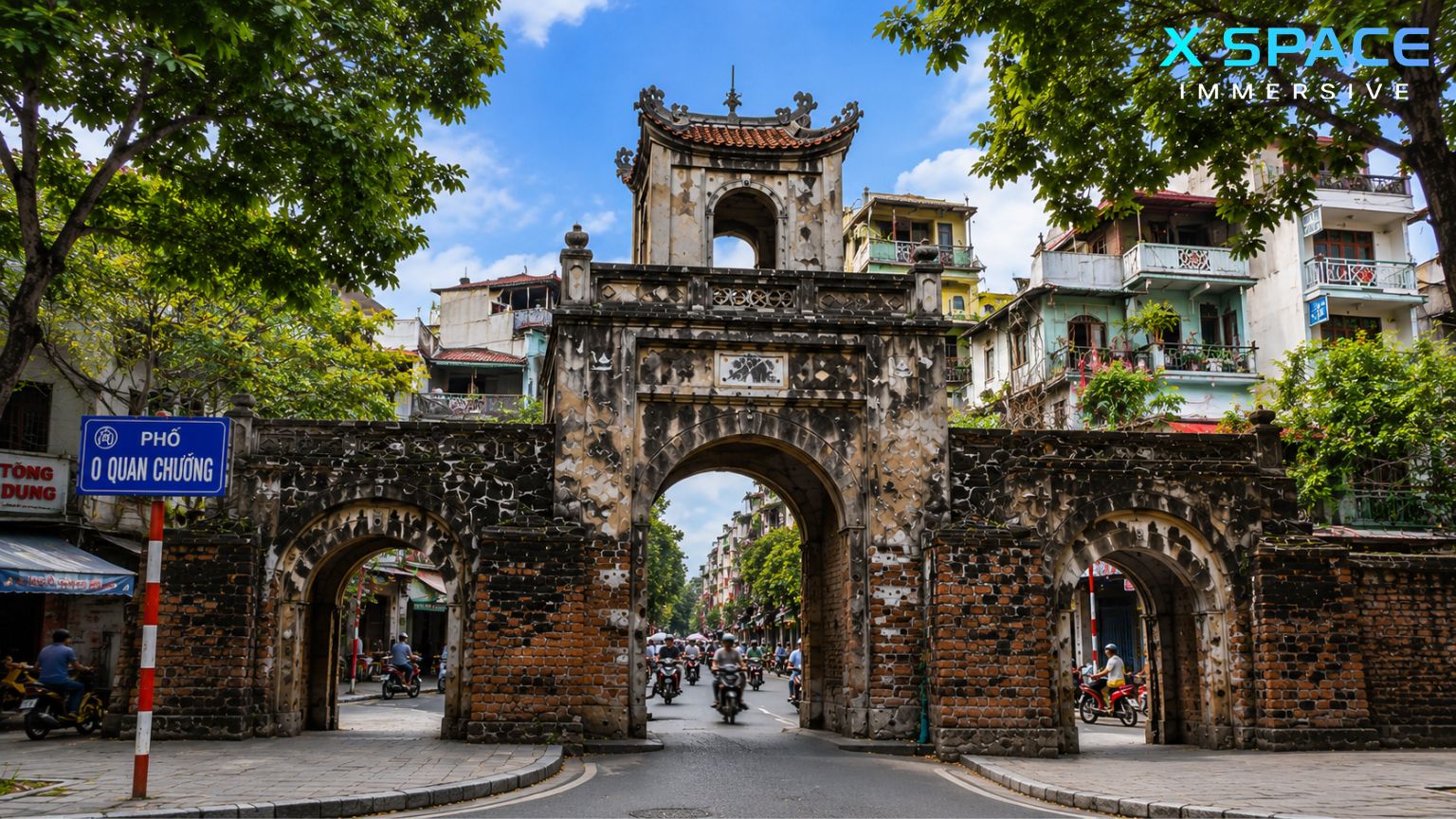
Old City Gate Hanoi and O Quan Chuong Gate street in the historic Hanoi Old Quarter
Old City Gate Hanoi, commonly called O Quan Chuong Gate, is a historic gateway located on the eastern side of Hanoi’s Old Quarter.
Its historical name is Dong Ha Mon, or Dong Ha Gate. According to information published by Hoan Kiem’s tourism portal, the gate stands at the end of O Quan Chuong Street, connecting with the beginning of Hang Chieu Street. During the Le period, this area belonged to Thanh Ha village in Dong Ha ward, one of the historic quarters east of the old Thang Long capital.
Today, the structure feels almost unexpectedly modest.
There is no enormous ceremonial square separating it from everyday Hanoi. Instead, motorbikes pass through and around it, local vendors work nearby, and the narrow streets of the Old Quarter continue beyond its arches.
That is precisely what makes the gate fascinating.
Rather than being frozen as a museum piece, O Quan Chuong Gate remains part of the urban landscape. You can stand beneath an architectural structure that has witnessed centuries of Hanoi history while the contemporary city continues moving around you.
An Introduction to O Quan Chuong Gate
Historical sources indicate that the gate was first constructed in 1749, during the reign of King Le Hien Tong. It was later repaired and reconstructed, with significant work taking place during the Nguyen Dynasty.
It was one of numerous gateways that once provided access to the old city.
Historical records cited by Vietnam’s National Authority of Tourism indicate that early nineteenth-century Hanoi had as many as 21 city gates. Most disappeared as the capital expanded and changed, leaving O Quan Chuong as an exceptional surviving reminder of that earlier urban structure.
Where Is Old City Gate Hanoi Located?
The gate sits at the eastern edge of the Hanoi Old Quarter, around the junction of O Quan Chuong Street, Hang Chieu Street and Dao Duy Tu Street.
Its eastern side faces toward the Red River, while the western side opens toward Hang Chieu and the maze of streets forming the Old Quarter. Historically, this position was important because waterways were essential to trade and transportation in Thang Long.
Goods arriving from other regions could travel along the river before entering the commercial quarters through gateways such as this one.
Today, its location makes Old City Gate Hanoi easy to incorporate into an Old Quarter walking tour, particularly if you are also visiting Dong Xuan Market.
Why the Gate Is an Icon of Hanoi Old Quarter
The significance of O Quan Chuong is not based on scale.
It comes from survival.
Hanoi has experienced wars, colonial transformation, urban expansion and rapid modernization. Many physical traces of earlier city defenses disappeared during those changes.
O Quan Chuong remained.
Walking beneath the gate today therefore creates a tangible connection between modern Hanoi and the historical capital of Thang Long.
It is one of those places where history requires very little imagination: the old gateway is still standing, the streets are still busy, and people continue passing through much as generations did before them.
The History of Old City Gate Hanoi
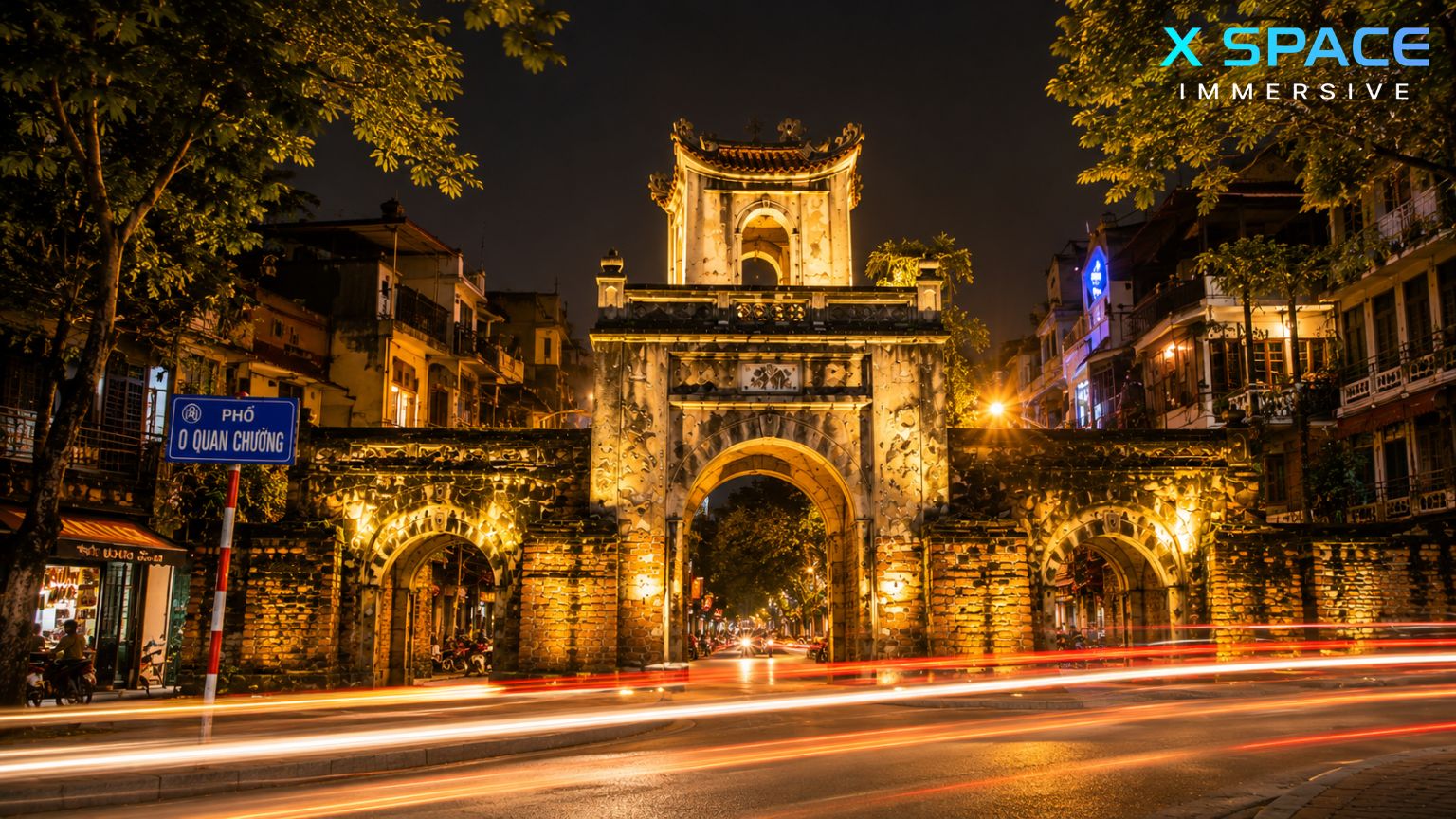
Old City Gate Hanoi illuminated at night, highlighting the historic O Quan Chuong Gate
Understanding the history behind Old City Gate Hanoi makes even a short visit far more meaningful.
The gate dates back to the eighteenth century, when Thang Long was already an important political and commercial center. City gates played both practical and defensive roles, controlling movement between the urban area and surrounding settlements.
The Origins of O Quan Chuong Gate
The gate was originally associated with the name Dong Ha Mon, meaning the gate of Dong Ha ward.
Vietnam’s National Authority of Tourism records that it was first built in 1749. The structure subsequently underwent repairs and reconstruction, including work during the reign of Emperor Gia Long. The form visitors see today reflects these later renovations.
Its position toward the Red River was particularly important.
The river was not simply a scenic landmark. For centuries, it functioned as one of northern Vietnam’s major transportation and commercial routes. Agricultural products, handicrafts and other goods arrived in Thang Long by water before continuing into the city’s trading streets.
The gate therefore stood at a meaningful transition point: between river and city, outside and inside, travelers and merchants, movement and settlement.
How the Gate Survived Hanoi’s Historical Changes
Hanoi changed dramatically during the nineteenth and twentieth centuries.
Old defensive structures lost their original purpose. Streets expanded, colonial planning altered the urban landscape, and later development transformed the city again.
Yet O Quan Chuong survived.
It underwent restoration rather than disappearing entirely, allowing later generations to see a physical trace of Hanoi’s former system of city gateways.
Today, the gate’s value lies not only in its age but also in its rarity. According to Vietnam’s National Authority of Tourism, it is the only ancient gate of this kind still surviving in Hanoi.
The Meaning Behind the Name “O Quan Chuong”
The name O Quan Chuong carries its own story.
The site’s official historical name is Dong Ha Mon, but local people have long called it O Quan Chuong.
Several explanations for the popular name have circulated over time. One widely repeated account connects it to a military commander who defended the gate when French forces attacked Hanoi in 1873. Vietnam’s National Authority of Tourism notes that the name commemorates a commander and soldiers who fought during the first French attack on Hanoi Citadel.
Hoan Kiem’s tourism portal also notes that several traditions exist regarding the exact origin of the name, including the story of a commander and his soldiers who died defending the gate.
Whatever the precise evolution of the popular name, O Quan Chuong has become deeply embedded in Hanoi’s cultural memory.
Architecture of O Quan Chuong Gate
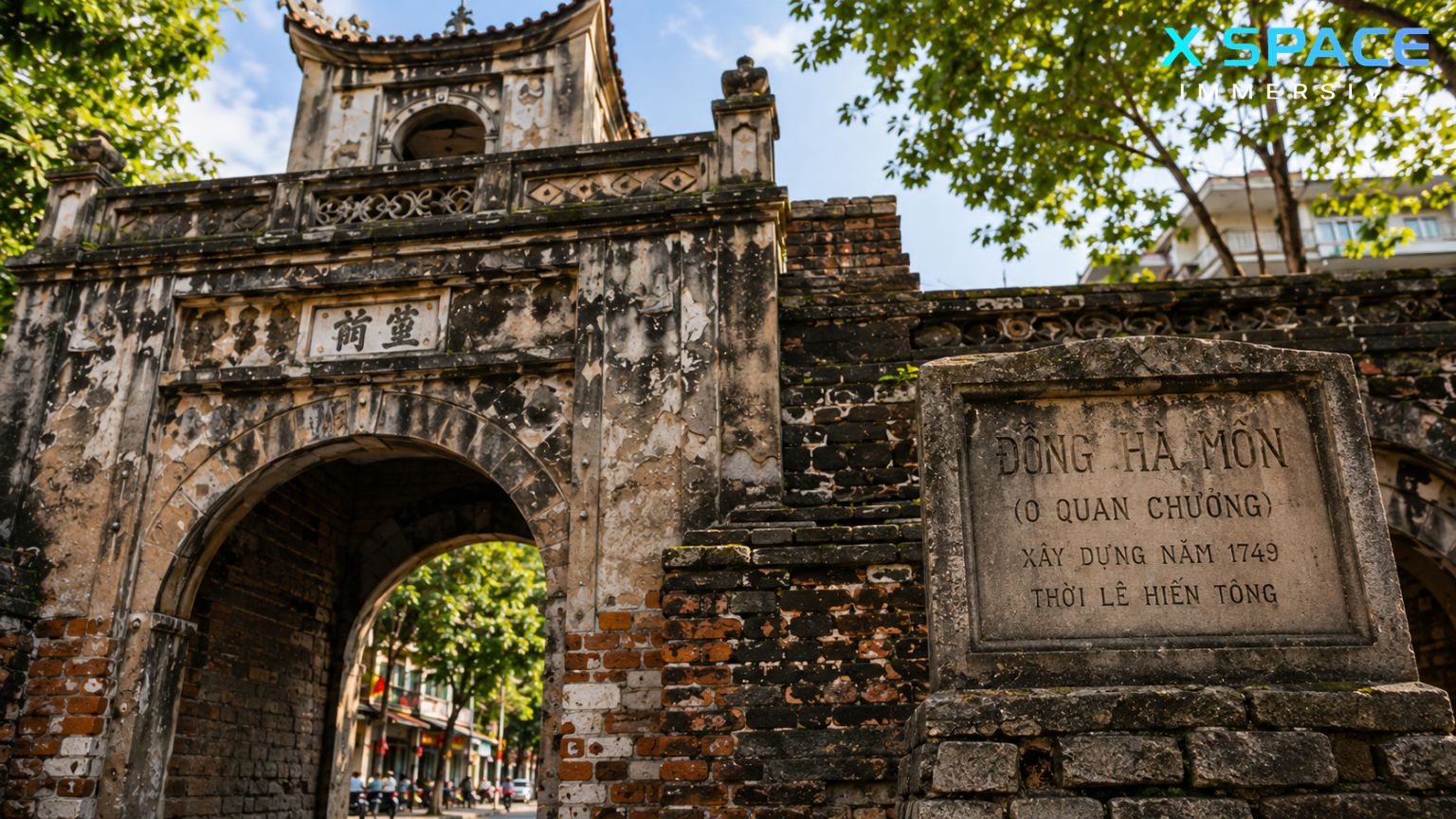
Traditional architecture and historic brickwork of O Quan Chuong Gate in Hanoi
At first glance, the architecture of O Quan Chuong Gate appears simple.
Spend a little longer looking at it, however, and the structure begins to reveal the logic of an old defensive gateway.
Traditional Vietnamese Architectural Features
The surviving gate consists of two levels.
The lower level contains three arched passages: a large central entrance and two smaller openings on either side. According to Vietnam’s National Authority of Tourism, the central passage is approximately three meters high and wide, while each side passage is about 1.65 meters wide and 2.5 meters high.
Above the central entrance sits a traditional pavilion or watchtower.
Its curved roof and compact proportions give the structure a distinctly Vietnamese architectural character, while its elevated position reflects its former defensive and observational function.
The gate’s east-facing orientation also reveals its historical relationship with the Red River and the trading routes beyond the city.
The Watchtower, Arched Entrance and Defensive Structure
The three openings are among the most recognizable features of Old City Gate Hanoi.
Historically, the central passage would have handled movement through the gate, while the elevated structure provided guards with a position from which to observe activity around the entrance.
The arrangement creates an architectural composition that is both practical and symbolic.
Unlike monumental gates designed purely for ceremony, O Quan Chuong was connected to the functioning city. People, goods and commerce moved through this area.
That practical history remains visible today.
Details That Make Old City Gate Hanoi Unique
One particularly interesting detail is a stone stele associated with Hoang Dieu, the governor of Hanoi.
Historical accounts state that the stele recorded instructions prohibiting guards from harassing or extorting people passing through the gate.
It is a small detail, but one that makes the monument feel unexpectedly human.
History here is not only about rulers and battles. It is also about merchants, residents, guards and ordinary people navigating daily life in the city.
Look above the main passage and you can also see Chinese characters associated with the gate’s historical identity as Dong Ha Mon.
These architectural and written traces transform O Quan Chuong from a picturesque old structure into a document of urban life.
Why Old City Gate Hanoi Is Worth Visiting
Hanoi has larger monuments.
It has grander temples, more elaborate museums and attractions that require considerably more time to explore.
So why visit Old City Gate Hanoi?
Because few places capture the continuity of Hanoi quite as naturally.
A Rare Surviving Gateway of Ancient Hanoi
The most compelling reason is simple: this is a rare physical survivor from Hanoi’s old urban landscape.
When you walk through the gate, you are passing through a space that generations of Hanoi residents used long before tourism existed in its modern form.
That makes the experience remarkably direct.
You do not need a long historical explanation to appreciate it. The worn brickwork and traditional roof already suggest how much the surrounding city has changed while the gate remained.
A Glimpse Into the Heritage of the Old Quarter
The Hanoi Old Quarter is often introduced through food, shopping and its famous “36 streets.”
But its identity is deeper than the colorful shopfronts visitors see today.
The neighborhood developed through centuries of commerce, craft traditions, migration and interaction with waterways surrounding the old capital.
O Quan Chuong Gate provides context for that story.
Visit it before walking deeper into the Old Quarter and the streets can begin to feel different. Hang Chieu is no longer simply another busy road—it becomes part of a historic route leading into the trading city.
Best Photo Spots Around O Quan Chuong Gate
The gate is especially photogenic because it remains surrounded by everyday street life.
Rather than searching for a perfectly empty frame, embrace that atmosphere.
Photograph the main arch with passing bicycles or motorbikes to capture the contrast between old architecture and contemporary Hanoi. Step back along Hang Chieu Street for a wider composition, or focus on details such as the curved roof, aged walls and upper pavilion.
Early morning is particularly appealing for softer light and a calmer atmosphere.
The result can feel much more authentic than a perfectly staged landmark photograph.
How to Visit Old City Gate Hanoi
One of the advantages of visiting Old City Gate Hanoi is that it requires very little planning.
You can easily include it in a morning or afternoon exploring the Old Quarter.
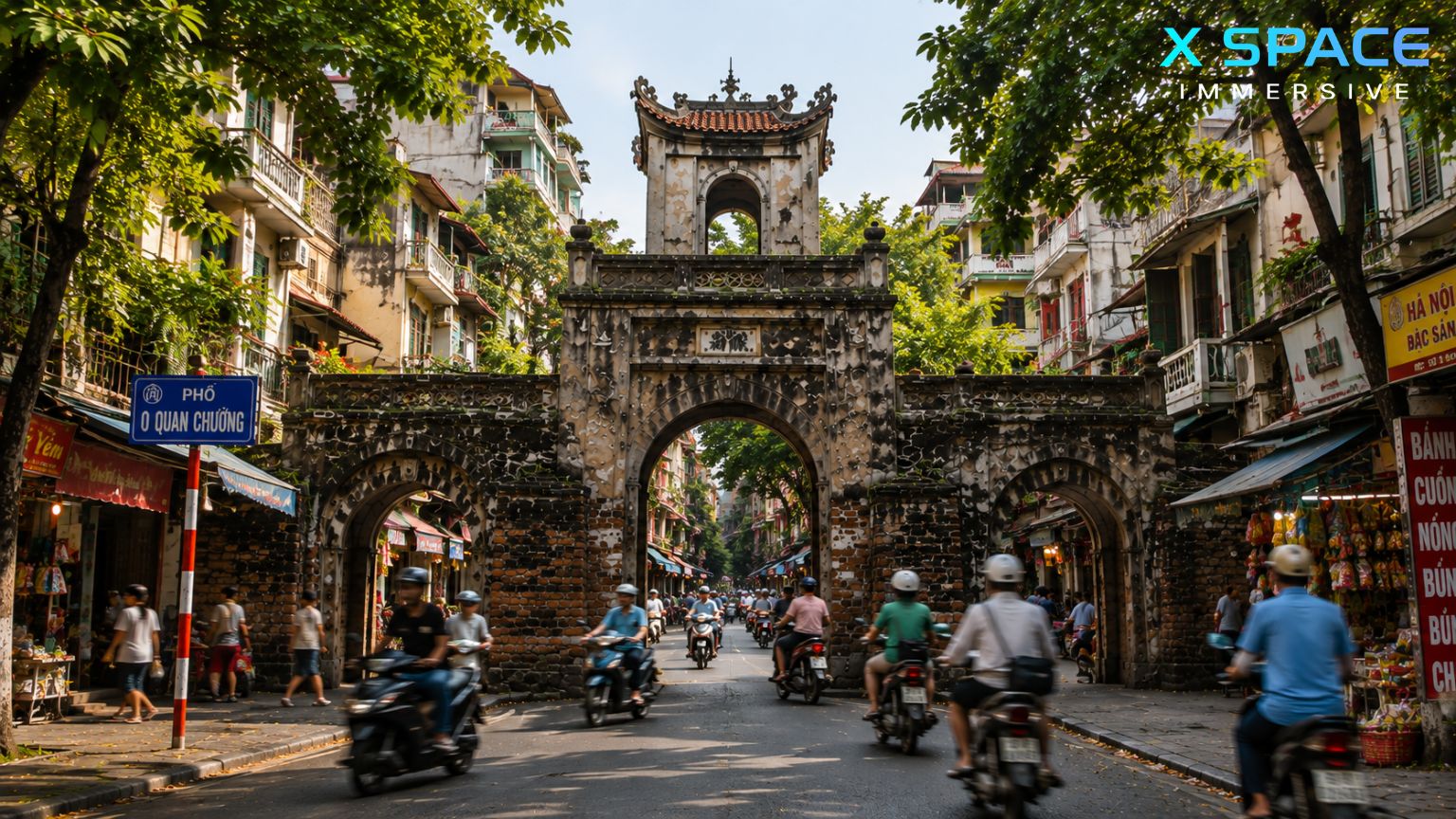
Old City Gate Hanoi surrounded by motorbikes and local life in the Hanoi Old Quarter
Location and How to Get There
O Quan Chuong is located near the eastern side of Hanoi’s Old Quarter, close to Dong Xuan Market and within walking distance of many central attractions.
If you are already staying in the Old Quarter, walking is usually the most enjoyable option.
From the Hoan Kiem Lake area, simply head north through the historic streets. The walk itself becomes part of the experience, taking you past local stores, food stalls, old façades and the dense street life that defines central Hanoi.
Taxis and ride-hailing services are convenient if you are arriving from another part of the city.
Opening Hours and Entrance Fee
Unlike a conventional museum, O Quan Chuong Gate is integrated into the street environment.
Visitors can view the exterior as part of exploring the surrounding neighborhood, making it particularly easy to include in a flexible itinerary.
There is no need to devote half a day to the attraction. For most travelers, around 15–30 minutes is enough to observe the architecture, take photographs and appreciate the setting before continuing through the Old Quarter.
Best Time to Visit O Quan Chuong Gate
For photography and atmosphere, early morning is an excellent choice.
The streets tend to feel calmer, temperatures are often more comfortable, and morning light can highlight the textures of the old walls.
Late afternoon is another attractive option, especially if you plan to continue toward Hoan Kiem Lake for the evening.
The gate can also be atmospheric after dark, when artificial lighting and the movement of the surrounding streets create a very different mood.
Essential Tips for First-Time Visitors
Wear comfortable shoes because the gate is best experienced as part of a wider walking route.
Traffic around the Old Quarter can be busy, so pay attention when crossing streets or positioning yourself for photographs.
Most importantly, avoid treating the gate as an isolated attraction.
Its meaning becomes much clearer when you explore the streets around it. Give yourself time to wander through nearby markets, alleys and traditional commercial streets.
What to See Near Old City Gate Hanoi
One reason Old City Gate Hanoi works so well in a sightseeing itinerary is its location.
Several interesting Old Quarter attractions are nearby, allowing you to turn a brief stop at the gate into a much richer exploration of central Hanoi.
Explore the Streets of Hanoi Old Quarter
Begin simply by walking.
This is one of the best areas of Hanoi for unplanned exploration.
Traditional shopfronts sit beside cafés, street-food vendors and contemporary boutiques. Narrow façades rise above crowded pavements. Scooters weave through streets that have served commercial purposes for generations.
Instead of rushing from one attraction to another, allow time for these ordinary scenes.
They are part of the Old Quarter experience.
Dong Xuan Market
From O Quan Chuong, continue toward Dong Xuan Market, one of Hanoi’s best-known traditional markets.
The area around the market is especially interesting in the morning, when commercial activity spills into surrounding streets.
Even if you are not planning to shop, walking through the neighborhood offers an energetic contrast to the stillness of the old gate.
Bach Ma Temple
Continue south through the Old Quarter and consider stopping at Bach Ma Temple, another important historical site.
The temple provides a different perspective on the spiritual and cultural history of Thang Long and makes a natural addition to a heritage-focused walking route.
Together, O Quan Chuong and Bach Ma Temple help reveal that the Old Quarter is more than a shopping district—it is a landscape layered with centuries of history.
Hoan Kiem Lake and Nearby Attractions
Eventually, the maze of streets leads toward Hoan Kiem Lake, the symbolic heart of central Hanoi.
Walking around the lake offers a change of pace after the density of the Old Quarter.
From here, travelers can continue to Ngoc Son Temple, explore the surrounding French-influenced streets, stop for Vietnamese coffee, or simply find a bench and watch the city.
Suggested Old Quarter Walking Route From O Quan Chuong Gate
A walking route is arguably the best way to experience Old City Gate Hanoi because it allows you to understand the monument in relation to the neighborhood around it.
O Quan Chuong Gate to Dong Xuan Market
Start your journey at O Quan Chuong in the morning.
Spend a few moments examining the arches and upper pavilion before walking west into the Old Quarter.
From here, continue toward Dong Xuan Market.
This short section immediately introduces you to the commercial energy that has characterized the neighborhood for generations.
Discover Hanoi’s Ancient Streets and Local Life
After exploring the market area, wander south through the Old Quarter rather than following the fastest route.
This is where Hanoi rewards curiosity.
Turn down a narrow street because the architecture looks interesting. Stop for a bowl of noodles when you see a busy local stall. Watch a vendor preparing fruit. Look upward at balconies and old façades that are easy to miss when concentrating only on street level.
The Old Quarter is not simply a collection of landmarks.
Its greatest attraction is the experience of moving through it.
Continue Toward Hoan Kiem Lake
Finish the walking route around Hoan Kiem Lake.
Depending on your pace and the number of stops you make, the journey can occupy several enjoyable hours.
By this point, you will have moved symbolically through several layers of Hanoi: from an eighteenth-century gateway to an old trading quarter and finally into the energetic center of the modern capital.
And if you want to continue that journey—from Hanoi’s historic past toward a completely different expression of the city—there is another experience worth adding to your itinerary.
Experience X Space Immersive – Step Into Hanoi’s Heritage in a New Way

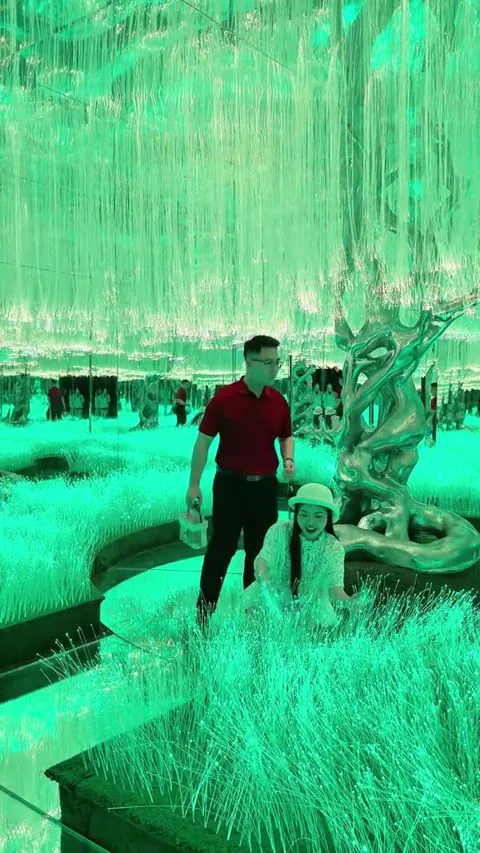
Visitors enjoying the X Space Immersive experience in Hanoi
After spending hours among ancient streets, traditional architecture and historic landmarks, changing the atmosphere completely can make your day in Hanoi even more memorable.
This is where X Space Immersive offers an interesting contrast.
Located inside Vincom Mega Mall Royal City at 72A Nguyen Trai Street, Thanh Xuan, Hanoi, X Space Immersive is an indoor digital art and immersive technology experience built around light, projection, sound, interactive visuals and spatial environments.
Where O Quan Chuong invites you to look backward into Hanoi’s history, X Space offers an opportunity to experience a more contemporary world shaped by digital creativity.
Discover Hanoi Beyond Traditional Sightseeing
X Space Immersive is designed around multiple themed environments rather than the conventional museum experience of observing objects from a distance.
According to its official website, the experience includes visual environments such as a Full LED Tunnel, Neon Art Room, Immersive Dome Story, Enchanted Jungle, Deep Ocean, Magic Tunnel, Wonderland, Space Dome and Light Forest, alongside features including 3D mapping, a 360-degree immersive dome and touch-responsive interactive technology.
The emphasis is on being surrounded by the visuals.
Light shifts across walls and floors. Digital landscapes transform the space around visitors. Mirrors, projections and LED environments play with depth and perspective.
It is a different type of sightseeing—one based more on movement, sensation and interaction.
From Old City Gate Hanoi to an Immersive Cultural Journey
Pairing Old City Gate Hanoi with X Space Immersive creates an intriguing contrast.
At O Quan Chuong, you encounter physical history: old masonry, traditional architecture and a gateway that has survived centuries of change.
At X Space, technology becomes part of the environment.
Its official site highlights experiences including an immersive LED tunnel, an interactive Infinity Light Forest, a 360° Immersive Dome, Interactive 3D Mapping and a Magic Mirror Tunnel.
The transition between these places can become a simple way to experience two very different faces of Hanoi in one day.
Begin with history.
Walk through the Old Quarter.
Then step into an environment of digital light, movement and imagination.
Why Add X Space Immersive to Your Hanoi Itinerary
X Space can be particularly useful when you want a break from Hanoi’s outdoor sightseeing.
Because the attraction is indoors, it provides an alternative during rainy weather, hot afternoons or simply when you want to slow down after hours of walking.
It is also naturally suited to families, couples, groups of friends and travelers interested in photography or digital art.
The official experience currently offers different ticket options, with the standard experience covering Rooms 1–7 for approximately 60 minutes, while the full experience covers all eight rooms for approximately 80 minutes. The official site lists opening hours as 10:00 AM–10:00 PM Monday to Friday and 9:30 AM–10:00 PM on weekends and public holidays. Ticket prices and schedules can change, so checking the official website before visiting is recommended.
Hanoi is most rewarding when you allow its different layers to exist side by side.
You can stand beneath O Quan Chuong Gate, surrounded by architecture that has watched the city change for centuries, then walk through the restless streets of the Old Quarter, follow the flow of local life toward Hoan Kiem Lake, and later enter a completely different environment filled with digital light and immersive technology.
That contrast is part of Hanoi’s appeal.
The capital does not ask you to choose between old and new.
It lets you experience both.
And perhaps that is the best reason to visit Old City Gate Hanoi in the first place. It is more than a surviving monument. It is a reminder that Hanoi’s past has never entirely disappeared—it continues to stand quietly within the modern city, waiting for curious travelers to notice it.
Was this article helpful?
Thanks for your feedback!