Thap Rua Tower: Discover Hanoi’s Iconic Turtle Tower Landmark

In the heart of Hanoi, where the city’s lively streets meet the calm waters of Hoan Kiem Lake, a small ancient-looking tower rises quietly from a tiny island. This is Thap Rua Tower, one of the most recognizable symbols of Vietnam’s capital.
At first glance, the tower may seem modest compared with Hanoi’s grand temples, colonial buildings, and modern skyscrapers. Yet its appeal lies precisely in that simplicity. Surrounded by water and framed by old trees, Thap Rua Tower Hanoi carries stories of history, legend, architecture, and local identity that have become deeply intertwined with the city itself.
Known in English as Thap Rua Turtle Tower or Thap Rua Tortoise Tower, this landmark is more than a picturesque structure in the middle of a lake. For generations, it has stood alongside the legendary story of the Returned Sword, witnessed Hanoi transform through different historical periods, and become an enduring image associated with the capital.
Whether you are visiting Hanoi for the first time or simply want to understand the stories behind its familiar landmarks, discovering Thap Rua offers a beautiful introduction to the city’s cultural soul.
In this guide
Introduction to Thap Rua Tower
Thap Rua Tower, known locally as Tháp Rùa, stands on a small island in Hoan Kiem Lake in central Hanoi. Its secluded position makes it particularly striking: while busy streets, cafés, shops, and historic neighborhoods surround the lake, the tower remains quietly separated from the bustle by the water.
This contrast is part of its charm.
Walk along the lakeside in the early morning and you may see residents practicing tai chi beneath leafy trees while the tower appears through a thin layer of mist. Return at sunset, and its silhouette takes on warmer tones against the changing sky. After dark, reflections and city lights create yet another atmosphere.
For many travelers, seeing Thap Rua Tower Hanoi is one of those simple moments that captures Hanoi perfectly—a city where centuries-old stories continue to exist naturally alongside everyday modern life.
The tower is also closely associated with Hoan Kiem Lake’s legendary turtle and the story of Emperor Le Loi returning a magical sword. As a result, architecture, history and folklore come together in one compact but meaningful landmark.
Where Is Thap Rua Tower in Hanoi?
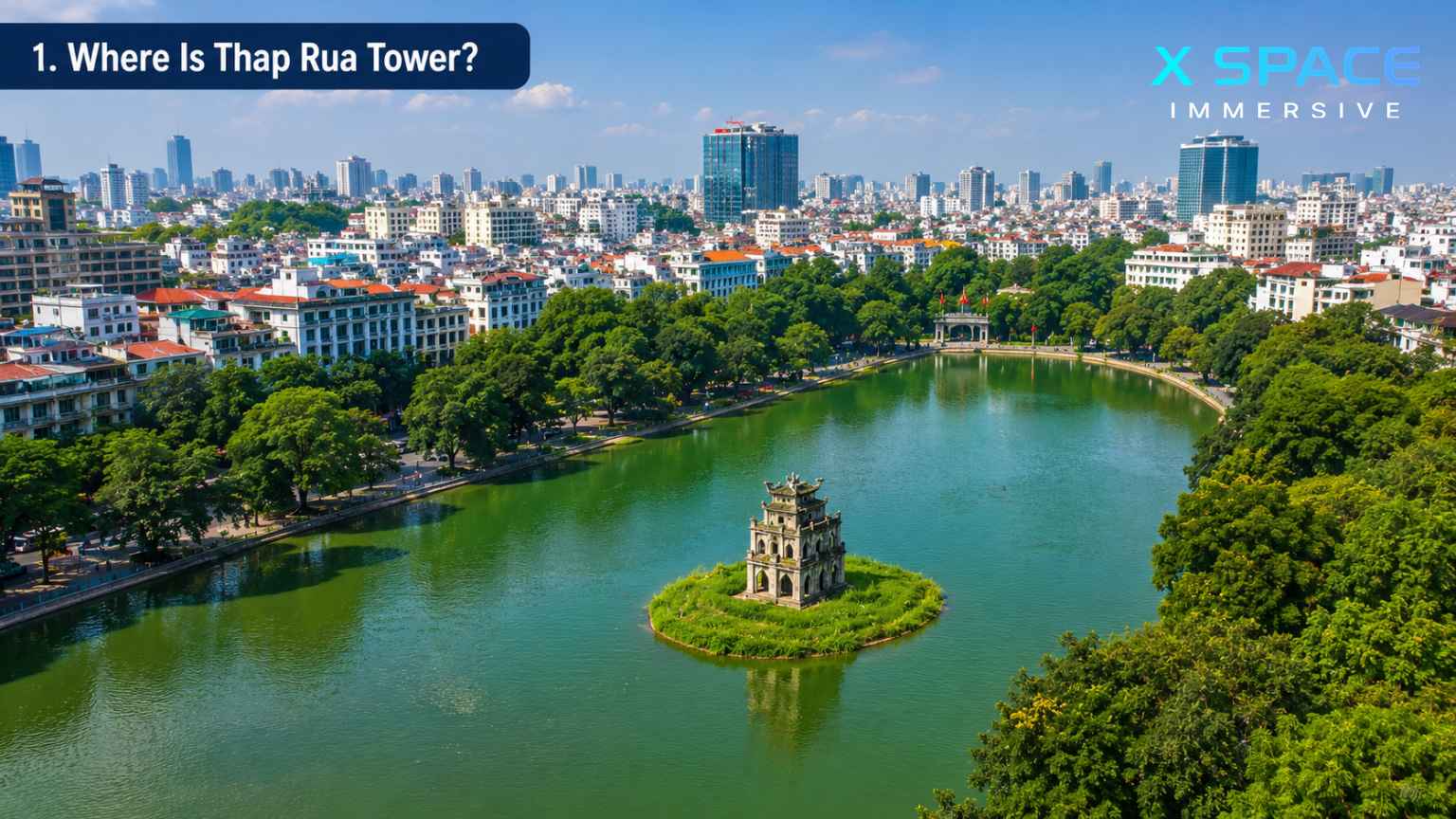
Aerial view of Thap Rua Tower in Hoan Kiem Lake, Hanoi city center
Thap Rua Tower is located on a small island near the center of Hoan Kiem Lake, in Hanoi’s historic core.
The lake sits beside the Old Quarter, making it one of the easiest landmarks to include in a walking tour of central Hanoi. From many streets in the Old Quarter, visitors can reach the lakeside within minutes and continue exploring on foot.
Unlike a conventional attraction with an entrance gate, ticket counter, and visitor route, the experience of seeing Thap Rua Tower happens primarily from around the lake.
The tower itself sits separately on its island, so most visitors admire and photograph it from the shore. This distance arguably contributes to its visual appeal. Seen across the water, the tower appears almost like a scene from an old painting, particularly when Hanoi’s trees and historic architecture form the background.
Hoan Kiem Lake is also a useful geographical reference point for exploring central Hanoi. From here, travelers can continue toward Ngoc Son Temple, The Huc Bridge, the Old Quarter, Hanoi Opera House and many other attractions.
How to Get to Thap Rua Tower
If you are staying in Hanoi’s Old Quarter, walking is usually the most enjoyable way to reach Hoan Kiem Lake. The journey gives you a chance to experience narrow streets, traditional shop houses, cafés, street vendors and the constant rhythm of central Hanoi.
Visitors staying farther away can reach the area by taxi, ride-hailing services, buses, or private transportation before continuing on foot around the lake.
Once you arrive, there is no need to follow a complicated route. A leisurely walk along the lakeside offers several perspectives of the tower.
Rather than rushing to take a photograph and leave, consider completing a circuit around Hoan Kiem Lake. Different sections of the shore reveal subtly different views of Thap Rua Tower, especially as the light changes throughout the day.
The History of Thap Rua Tower
The history surrounding Thap Rua is one reason this seemingly small landmark attracts so much interest.
The present tower dates to the late 19th century. It was built during a complicated period in Hanoi’s history, when Vietnam was undergoing major political and social changes and French colonial influence was increasingly visible in the capital.

Legend of the Returned Sword with the Golden Turtle at Hoan Kiem Lake near Thap Rua Tower
The structure commonly seen today is associated with Nguyen Ngoc Kim, also known as Ba Ho Kim. Historical accounts surrounding its construction include stories about his intention to build a tower on the island and his reported desire to use the site as a burial place for his father.
Whatever the original motivations behind its construction, the tower gradually acquired a significance far beyond the circumstances of its creation.
Its location played an important role.
The island already belonged to a landscape rich in history and legend. Over time, the tower became visually inseparable from Hoan Kiem Lake and, consequently, from Hanoi itself.
Today, most visitors are less likely to see it merely as a late-19th-century structure. Instead, Thap Rua Tower is understood as part of a much larger cultural landscape connecting architecture, national legends, historical memory and the everyday life of the capital.
Who Built Thap Rua Tower?
The present-day tower is generally associated with Nguyen Ngoc Kim, commonly called Ba Ho Kim, who had the structure built in the late 19th century.
Stories about its construction are sometimes mixed with local anecdotes, political interpretations and later retellings. This makes it useful to distinguish the documented history of the present building from the much older legends associated with Hoan Kiem Lake.
The tower itself does not date back to the era of Emperor Le Loi.
Instead, its powerful connection with the legend developed because it occupies the small island in the legendary lake. Over time, these layers of history and folklore blended into the cultural identity visitors recognize today.
How Old Is Thap Rua Tower?
The present Thap Rua Tower dates from the 1880s, meaning it has stood in Hoan Kiem Lake for well over a century.
However, the cultural history of the lake surrounding it reaches much further back.
This distinction makes Thap Rua particularly interesting. The physical building belongs largely to Hanoi’s late-19th-century history, while the stories and symbolism attached to its location connect visitors to events and legends associated with earlier centuries.
It is therefore best understood not as an isolated monument, but as one layer within Hanoi’s much longer historical story.
Why Is It Called Thap Rua Tortoise Tower?
The Vietnamese name Tháp Rùa can be translated literally as “Turtle Tower.”
This explains why international travel guides and English-language resources sometimes use several versions of the name, including Thap Rua Tower, Thap Rua Turtle Tower, and Thap Rua Tortoise Tower.
The word tháp means “tower,” while rùa refers to a turtle or tortoise.
But the name carries meaning beyond a straightforward translation.
Turtles have a special connection with Hoan Kiem Lake because of the famous legend involving Emperor Le Loi, a magical sword, and the Golden Turtle. This story also explains the lake’s Vietnamese name, Hồ Hoàn Kiếm, commonly translated as the “Lake of the Returned Sword.”
For visitors, understanding this legend transforms the tower from a scenic photo subject into a gateway to one of Hanoi’s most famous cultural stories.
Thap Rua Tower vs. Thap Rua Turtle Tower: Are They the Same?
Yes. Thap Rua Tower, Thap Rua Turtle Tower, and Thap Rua Tortoise Tower all refer to the same landmark in Hoan Kiem Lake.
The differences simply come from translation and naming conventions.
“Thap Rua Tower” retains the Vietnamese words Tháp Rùa while adding the English word “Tower.” “Turtle Tower” is the most direct English translation, while “Tortoise Tower” also appears in English-language descriptions.
So, if you encounter any of these names while planning your Hanoi trip, you are looking at the same iconic structure.
The Legend Behind Thap Rua Turtle Tower and Hoan Kiem Lake
To understand why Thap Rua Turtle Tower holds such a special place in Hanoi’s imagination, you need to know the legend of the Returned Sword.
The story is associated with Le Loi, the Vietnamese leader who fought against Ming occupation in the 15th century and later became Emperor Le Thai To.
According to the famous legend, Le Loi received a magical sword that helped him in the struggle to restore Vietnamese independence.
After victory had been achieved and Le Loi had become emperor, he was traveling on the lake when a giant Golden Turtle emerged from the water.
The turtle asked him to return the magical sword to its divine owner.
Le Loi handed over the sword, and the turtle disappeared beneath the surface.
From this story came the name Hoan Kiem, meaning “Returned Sword.”
Whether encountered as folklore, national legend, or cultural memory, the story remains one of the most famous narratives associated with Hanoi. It also explains why turtles have such powerful symbolic importance around the lake.
Standing on the shore and looking toward Thap Rua Tower, visitors are therefore seeing more than architecture. The surrounding landscape acts as a stage for a story that generations of Vietnamese people have known and retold.
The Golden Turtle and the Legend of the Returned Sword
The Golden Turtle is a particularly meaningful figure in Vietnamese cultural tradition.
Within the Hoan Kiem story, it serves as a divine messenger, appearing after Le Loi’s mission has been completed to reclaim the sacred sword.
The narrative carries themes of legitimacy, independence, responsibility, and the idea that divine assistance is granted for a purpose rather than permanent possession.
Turtles themselves also have long-standing symbolic associations in Vietnamese culture, including longevity and wisdom.
This helps explain why the image of a turtle resonates so strongly in the landscape surrounding Thap Rua Tower Hanoi.
The legend gives the lake its identity; the tower gives that identity a distinctive visual landmark.
Together, they create one of Hanoi’s most memorable cultural scenes.
Architecture of Thap Rua Tower
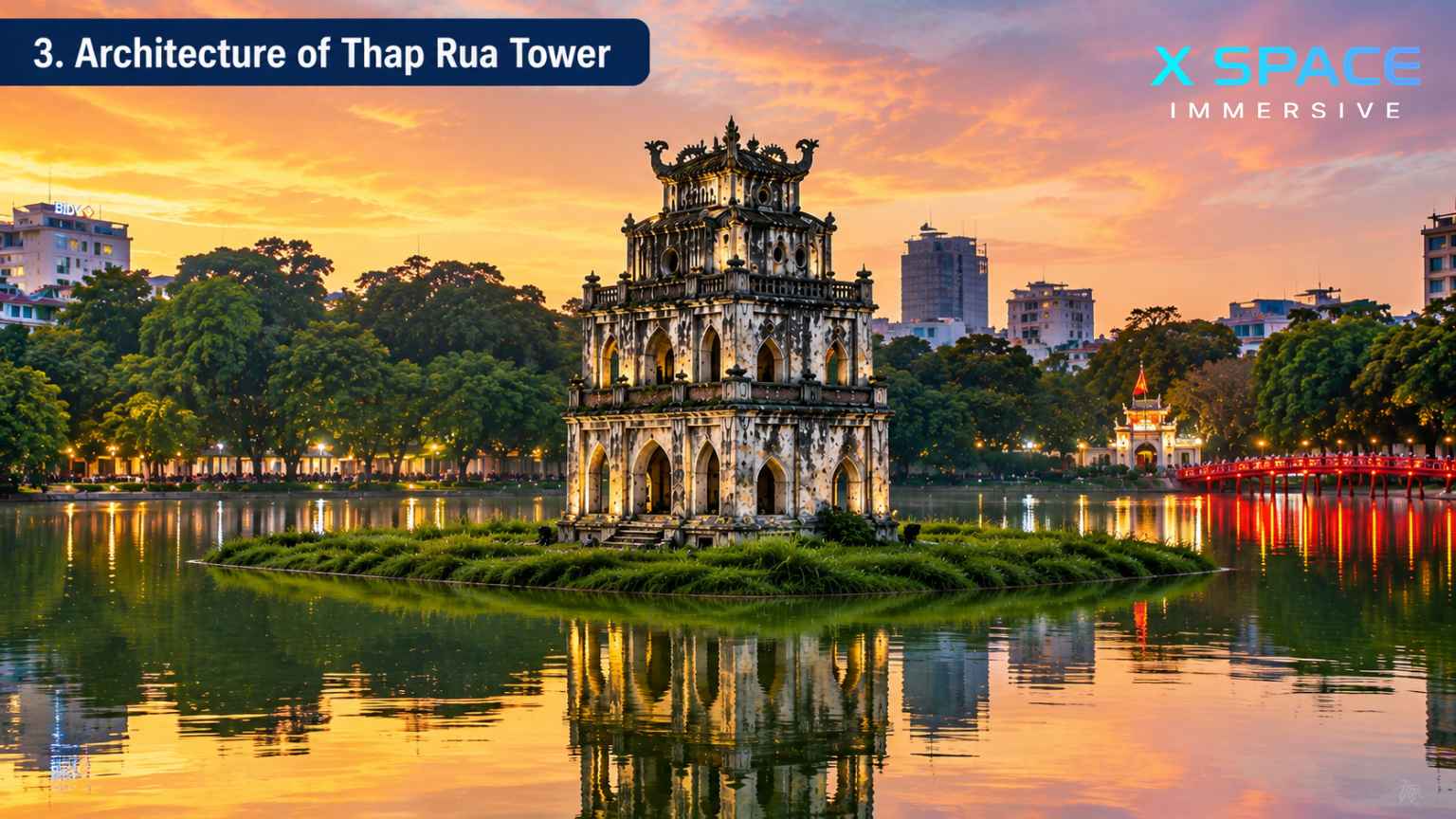
Architecture of Thap Rua Tower showing its historic multi-level design in Hoan Kiem Lake
Thap Rua is not enormous or extravagantly decorated. Its architectural beauty comes instead from proportions, location and character.
The tower is a compact, multi-level structure built on a small mound surrounded by the waters of Hoan Kiem Lake.
Arched openings appear throughout its façades, creating rhythm and allowing light and shadow to shape its appearance. The building’s architectural language reflects a period when traditional Vietnamese elements and Western influences were increasingly meeting in Hanoi.
This mixture gives Thap Rua Tower an appearance that does not fit neatly into a single architectural category.
From a distance, however, individual details become less important than the overall silhouette.
Its tiered form rising above the island creates a balanced composition with the lake. Trees, water, changing skies and reflections continuously alter how the tower looks throughout the day.
In many ways, the setting completes the architecture.
What Makes Thap Rua Tower Unique?
Few Hanoi landmarks have such a strong relationship with their surroundings.
The tower stands alone on its island, visually separated from the roads and buildings around Hoan Kiem Lake. That isolation makes even a relatively modest structure immediately noticeable.
Its uniqueness comes from several elements working together: its location in the water, historical character, distinctive architecture, connection with the turtle legend and role within Hanoi’s urban landscape.
Perhaps most importantly, it is remarkably photogenic.
A misty morning can make the tower appear mysterious. Bright daylight reveals architectural details more clearly. Sunset introduces softer colors, while evening illumination can create reflections on the lake.
The building remains the same, but Hanoi constantly changes the scene around it.
Cultural Significance of Thap Rua Tower Hanoi
Ask someone to imagine Hanoi and several images might immediately come to mind: crowded streets filled with motorbikes, bowls of steaming pho, old houses in the Old Quarter, red bridges, tranquil lakes—and Thap Rua Tower Hanoi standing in the middle of Hoan Kiem Lake.
Its importance today is largely symbolic.
The tower has become one of the visual signatures of the capital. It frequently appears in photographs, travel imagery, artwork, cultural representations and promotional materials associated with Hanoi.
But symbolism is not created by appearance alone.
Thap Rua occupies a location where different layers of Hanoi’s identity intersect. There is the legendary Hanoi of Emperor Le Loi and the Returned Sword; the historical city transformed during the colonial era; and the contemporary capital where residents still gather around the lake every day.
This continuity gives the landmark emotional weight.
For travelers, it may initially be a beautiful tower. For Hanoi, it is part of the city’s visual memory.
Best Time to See and Photograph Thap Rua Tower
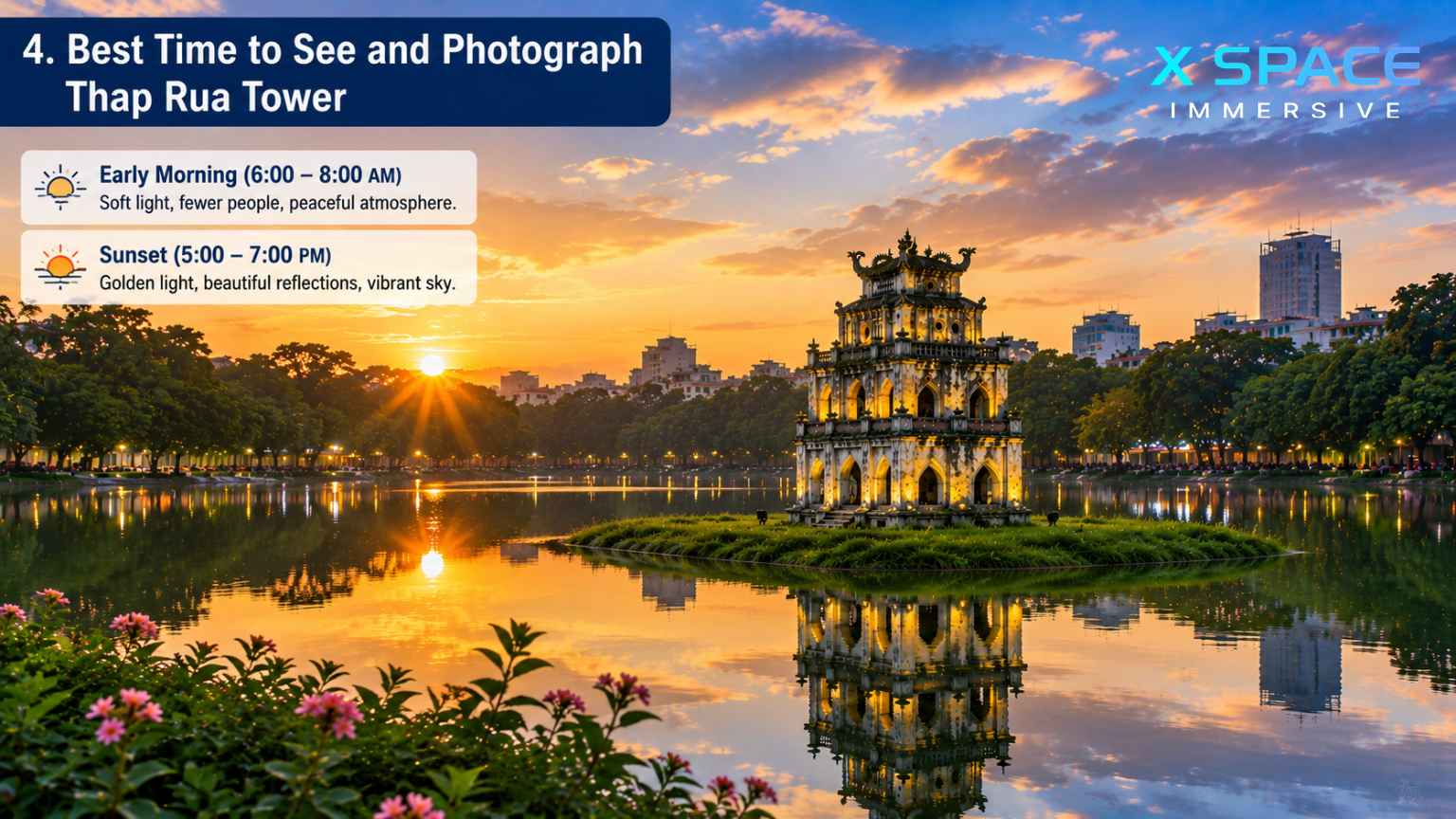
Thap Rua Tower at sunset with reflections on Hoan Kiem Lake, ideal time for photography
There is no single “correct” time to see Thap Rua. Each part of the day offers a different mood.
Early morning is ideal for travelers who prefer a quieter experience. Hanoi begins early, but the area around Hoan Kiem Lake can still feel remarkably peaceful compared with the busier hours that follow.
Morning light can also be gentle, especially when mist or humidity softens the skyline.
During the day, visibility is usually clearer and the architecture is easier to observe. This can be useful if you want detailed photographs of the structure.
Late afternoon and sunset bring warmer light and a more romantic atmosphere. As the sky changes, the water can reflect both the tower and surrounding cityscape.
Evening creates perhaps the strongest contrast between old and new Hanoi. The historic silhouette of Thap Rua Tower sits against the lights and movement of the modern capital.
Thap Rua Tower at Night
Seeing Thap Rua after sunset offers a very different experience from visiting during the day.
As lights appear around Hoan Kiem Lake, the tower becomes a focal point across the darker water. Reflections can stretch across the lake, while nearby streets become increasingly animated.
On evenings when pedestrian areas around the lake are lively, the contrast is especially interesting.
Families walk together, young people gather with friends, visitors take photographs, performers may appear in public spaces, and cafés remain busy—all while Thap Rua Tower stands quietly offshore.
For photography, try including reflections rather than framing only the tower. The water and surrounding lights can provide context and create a stronger sense of place.
Best Photo Spots Around Hoan Kiem Lake
One advantage of photographing Thap Rua is that you can experiment with viewpoints while walking around the lake.
Rather than searching for one “perfect” spot, pay attention to how trees, water and nearby architecture frame the tower.
A clear view across the lake works well for classic compositions. Tree branches can create a more atmospheric frame, while wider shots help communicate the relationship between the tower and central Hanoi.
Early morning is generally better if you want fewer people around the lakeside. Evening is preferable if your priority is atmosphere and city lights.
And sometimes the most memorable image is not a perfectly centered landmark shot. A cyclist passing beside the lake, an elderly resident exercising in the foreground, or a street vendor nearby can place Thap Rua Tower Hanoi within the everyday life that makes the city distinctive.
Things to Do Near Thap Rua Tower
Seeing Thap Rua itself may not require much time, but its location makes it an excellent starting point for exploring central Hanoi.
Begin with a walk around Hoan Kiem Lake. Instead of treating the area as a checklist of attractions, allow some time simply to observe the city.
You can then visit nearby cultural landmarks, explore the maze of streets in Hanoi’s Old Quarter, stop for Vietnamese coffee, discover local food, or continue toward the French Quarter.
This combination is one of the reasons the area works particularly well for first-time visitors.
Within a relatively compact district, you can experience different layers of Hanoi—legendary, historical, spiritual, architectural and contemporary.
Ngoc Son Temple and The Huc Bridge
One of the most natural places to visit after viewing Thap Rua Tower is Ngoc Son Temple.
Located on another island in Hoan Kiem Lake, the temple is reached via the distinctive red The Huc Bridge.
The vivid bridge, traditional temple architecture and surrounding water create one of Hanoi’s most recognizable scenes.
More importantly, visiting the temple provides additional cultural context for understanding Hoan Kiem Lake. Instead of seeing the area only as a picturesque public space, travelers begin to recognize how history, spirituality and folklore overlap here.
Together, Turtle Tower, Ngoc Son Temple and The Huc Bridge form an excellent introduction to Hanoi’s cultural landscape.
Explore Hanoi Old Quarter
From Hoan Kiem Lake, Hanoi’s Old Quarter is only a short walk away.
This is where the atmosphere changes quickly.
Quiet lakeside views give way to narrow streets filled with scooters, small shops, restaurants, cafés, street-food stalls and historic houses.
Traditionally, many streets in the Old Quarter were associated with particular trades or products. Although the district has evolved considerably, traces of this commercial heritage remain visible.
Allow yourself time to wander.
Try a local coffee, sample street food, observe old façades hidden between newer businesses and notice how daily life unfolds in tiny spaces.
The Old Quarter can feel chaotic at first, but that energy is part of the experience.
After the calm symbolism of Thap Rua Tortoise Tower, these lively streets reveal another equally important side of Hanoi.
Essential Tips for Visiting Thap Rua Tower
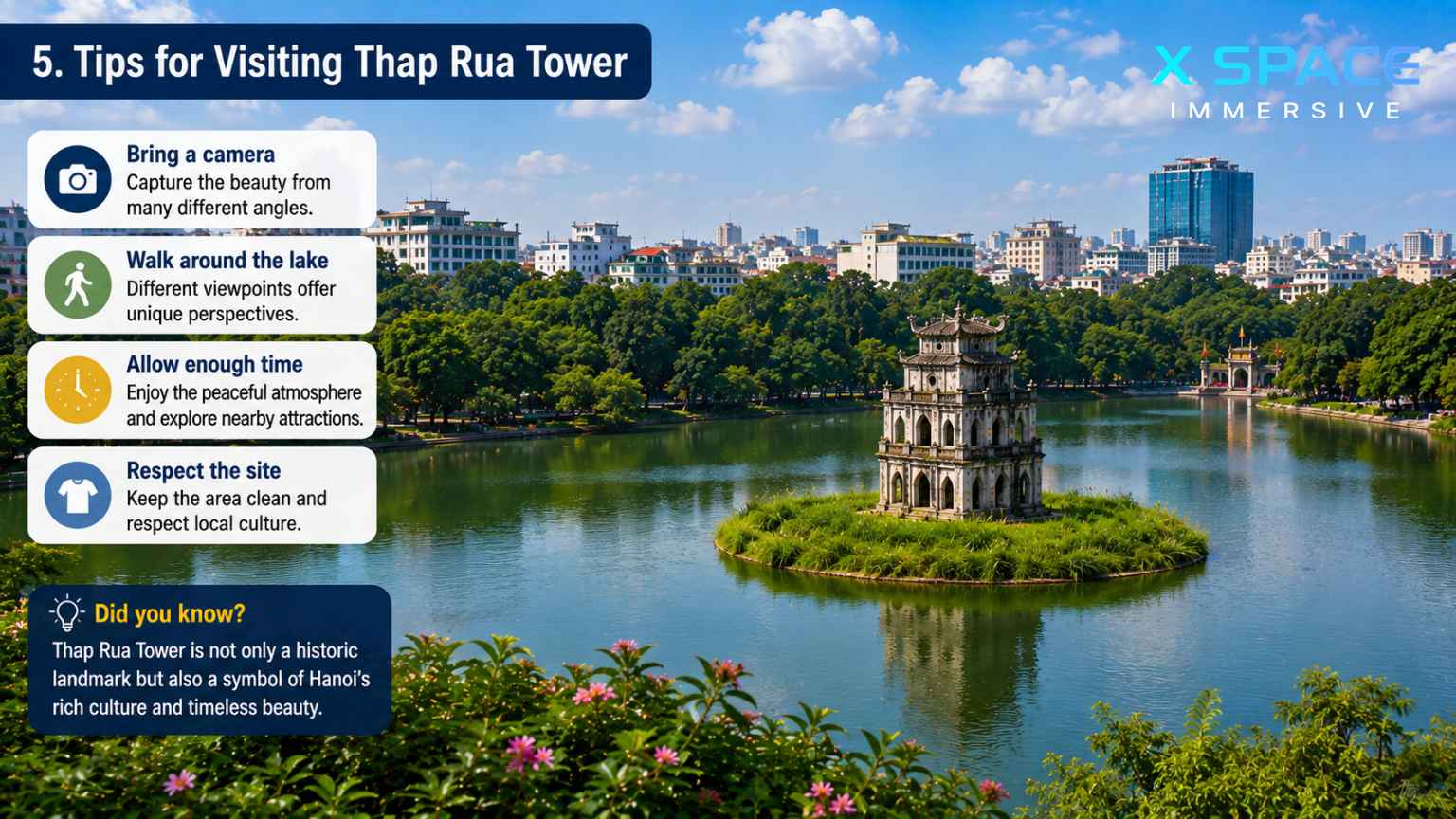
Thap Rua Tower Hanoi with travel tips for exploring and photographing Hoan Kiem Lake
Visiting Thap Rua is straightforward, but a few practical considerations can make the experience more enjoyable.
Comfortable walking shoes are useful because the best way to experience the area is on foot. Hanoi can be hot and humid, particularly during warmer months, so carrying water and sun protection is sensible.
If photography is important to you, visit early in the morning or around sunset. These periods generally provide softer light and a more atmospheric view of the lake.
Give yourself enough time to walk rather than simply stopping for one photograph.
Around one to two hours can be comfortable for a relaxed exploration of Hoan Kiem Lake, although you may want considerably longer if you combine the visit with Ngoc Son Temple, cafés, food stops and the Old Quarter.
When visiting temples or religious sites nearby, dress respectfully and follow posted guidelines.
Most importantly, experience the area at Hanoi’s pace.
Sit beside the lake for a few minutes. Watch residents exercise, families walk together and traffic flow beyond the trees. Thap Rua Tower becomes much more interesting when you understand it not as an isolated tourist attraction but as part of a living city.
Frequently Asked Questions About Thap Rua Tower
Where is Thap Rua Tower located?
Thap Rua Tower is located on a small island in Hoan Kiem Lake in central Hanoi, Vietnam. The lake sits beside Hanoi’s historic Old Quarter and is one of the city’s most recognizable public spaces.
Its central position makes the tower easy to include in a walking itinerary covering Hoan Kiem Lake, Ngoc Son Temple, The Huc Bridge and the Old Quarter.
Can tourists enter Thap Rua Tower?
Thap Rua is situated on a small island and is generally experienced from the shore rather than as a conventional walk-in tourist attraction.
Visitors can enjoy excellent views from several points around Hoan Kiem Lake.
If your priority is entering a historic site in the immediate area, consider combining your walk with Ngoc Son Temple, which is accessible via The Huc Bridge.
Is Thap Rua Tower the same as Turtle Tower?
Yes. Thap Rua Tower, Thap Rua Turtle Tower, Turtle Tower, and Thap Rua Tortoise Tower are names used for the same landmark.
“Tháp Rùa” is the Vietnamese name, commonly translated into English as “Turtle Tower.”
Why is Thap Rua Tower famous?
Thap Rua is famous because of its distinctive position in Hoan Kiem Lake, historical architecture, association with Hanoi’s cultural identity and connection to the legendary turtle story surrounding the Lake of the Returned Sword.
Its recognizable silhouette has also made it one of the most photographed and visually symbolic landmarks in central Hanoi.
Is Thap Rua Tower worth visiting?
Yes, particularly if you are already exploring central Hanoi.
The appeal is not simply the physical tower. Visiting the area allows you to experience Hoan Kiem Lake, discover the legend of the Returned Sword, observe everyday local life and explore several important attractions within walking distance.
It is an excellent starting point for understanding Hanoi beyond its busy streets.
What is the best time to visit Thap Rua Tower Hanoi?
Early morning and late afternoon are particularly attractive times to visit Thap Rua Tower Hanoi.
Morning offers a calmer atmosphere and a glimpse into local routines around Hoan Kiem Lake. Late afternoon provides softer light, while evening is ideal for visitors who want to experience the illuminated city and reflections on the water.
If possible, see the tower twice—once during daylight and again after sunset. The two experiences can feel surprisingly different.
From Hanoi’s Heritage to a New Journey: Experience X Space Immersive
A journey through Hanoi often begins with places that have witnessed history.
You walk beside Hoan Kiem Lake, look across the water toward Thap Rua Tower, hear the legend of the Returned Sword, cross streets lined with old façades, and gradually discover that Hanoi is not a city whose history exists only behind museum glass.
Here, heritage remains part of everyday life.
But discovering a destination does not have to stop at observing monuments from the outside.
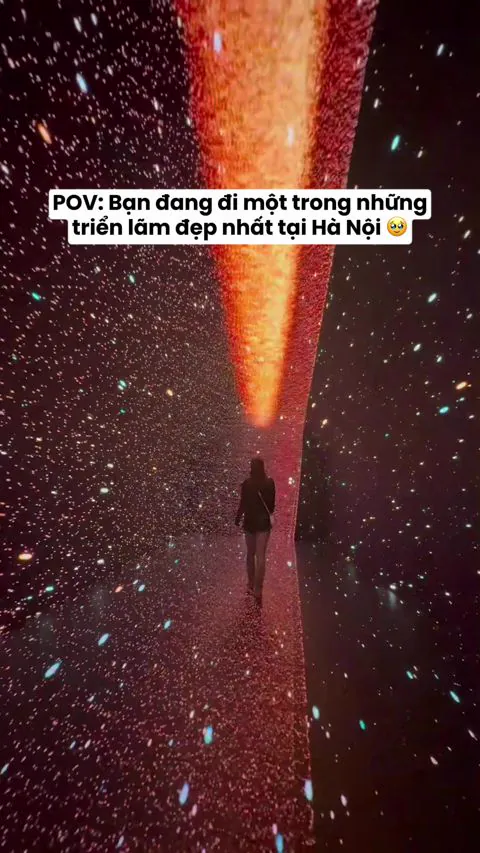
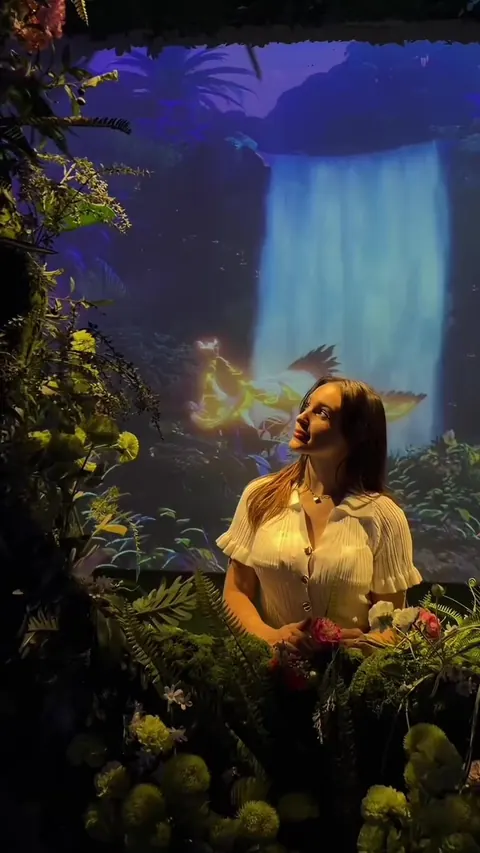
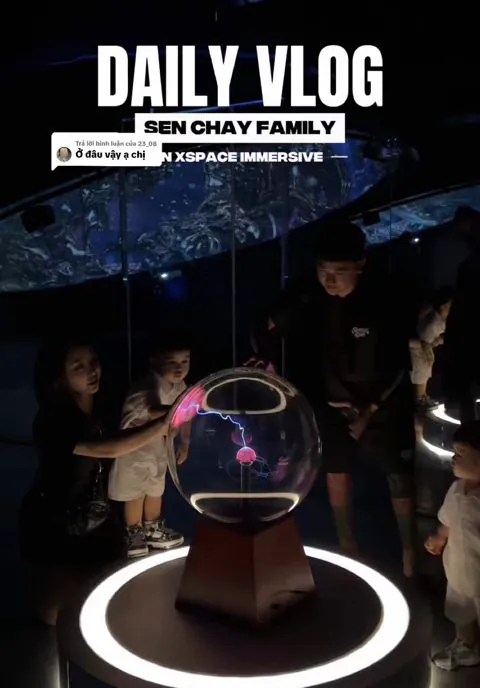
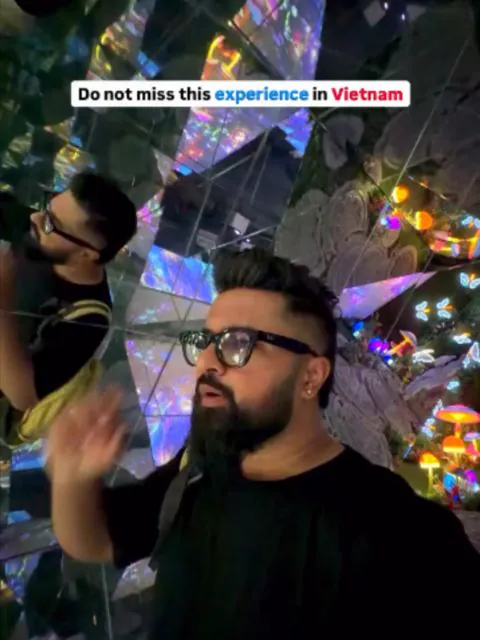
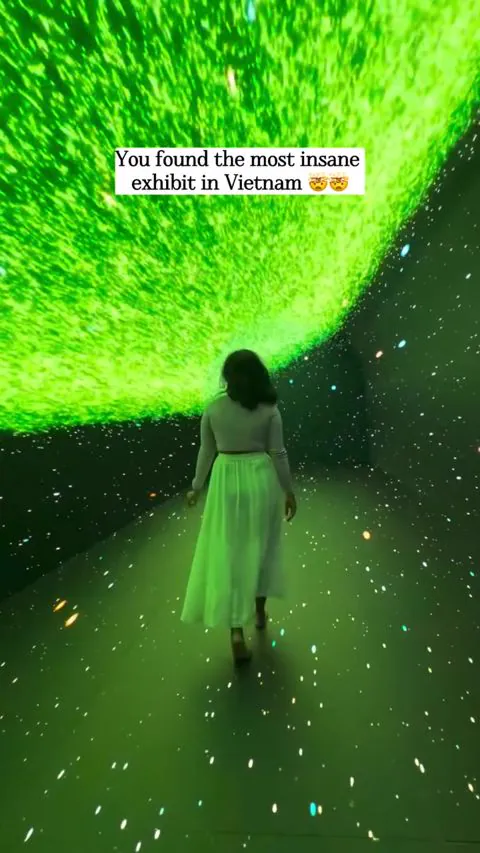
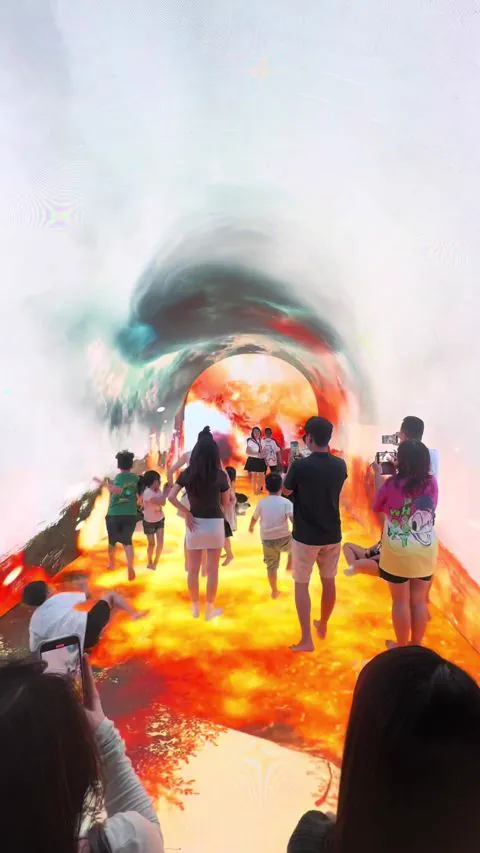
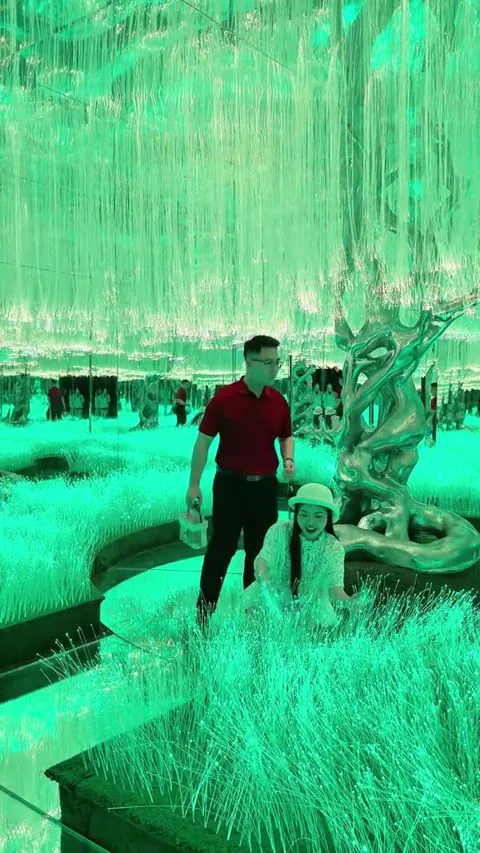
After exploring Hanoi’s historic landmarks, Experience X Space Immersive can open the door to another way of engaging with stories and culture—one shaped by immersive environments and contemporary technology.
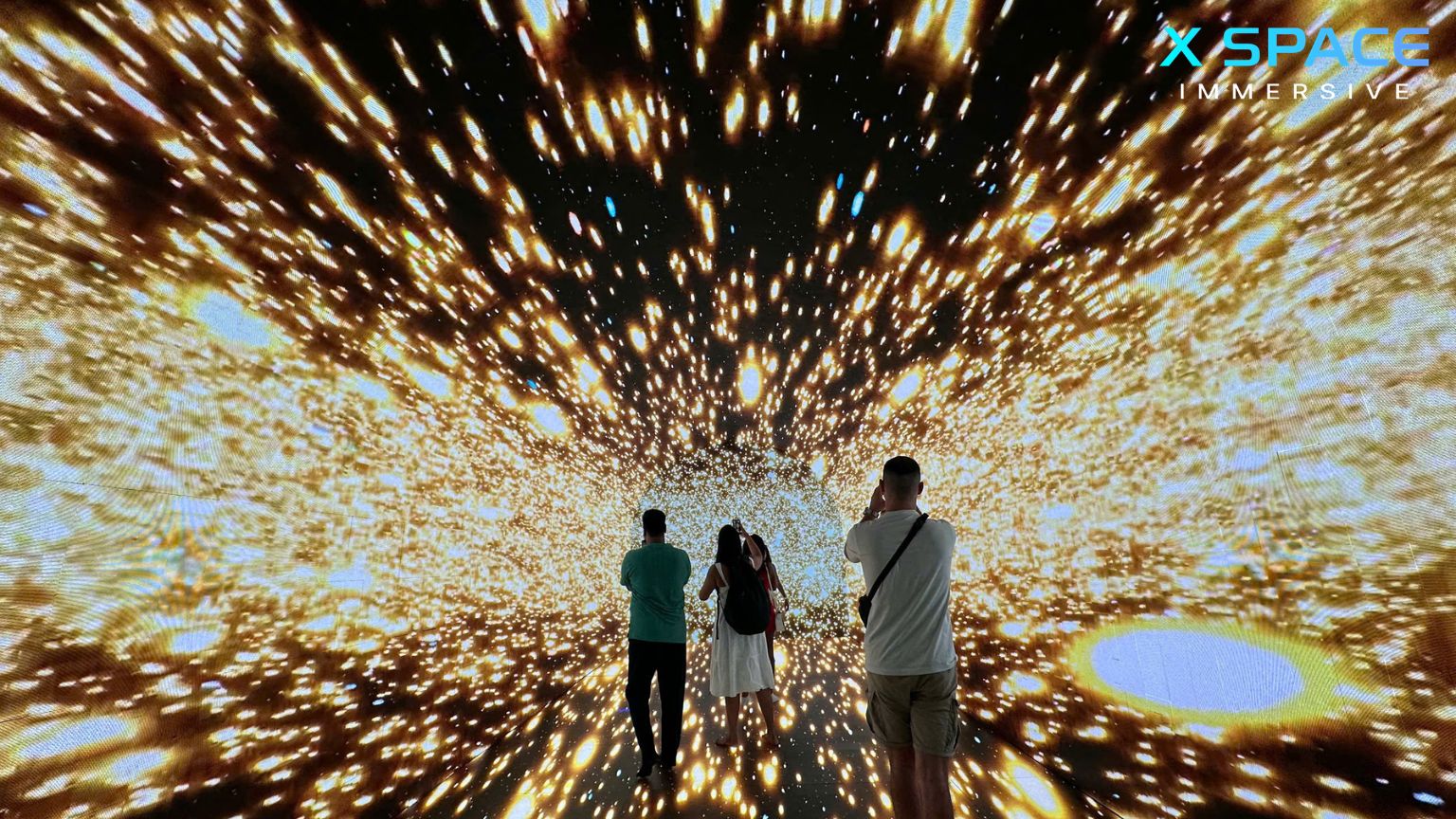
Visitors enjoying the X Space Immersive experience in Hanoi
Instead of simply looking at a scene, an immersive experience can invite you to step inside a carefully constructed world where visual storytelling, sound, space and technology work together.
That shift can be particularly meaningful after visiting a place such as Thap Rua.
At Hoan Kiem Lake, you encounter heritage through a physical landmark: a tower standing quietly in the water, surrounded by stories accumulated across generations. In an immersive space, storytelling can take on another dimension, creating an environment designed to be felt as well as seen.
It represents an interesting dialogue between two sides of Hanoi.
One preserves memory through monuments, lakes, temples and historic streets. The other explores how stories can be communicated through new forms of creativity and technology.
Together, they suggest that discovering Hanoi does not have to mean choosing between the past and the present.
Start beside the peaceful waters of Hoan Kiem Lake. Take your time looking toward Thap Rua Turtle Tower and imagining the layers of history and legend behind its familiar silhouette. Wander through the Old Quarter and experience the rhythms of the city beyond the postcards.
Then continue your journey in a different way.
Experience X Space Immersive and discover how storytelling can move beyond what you simply see – into a world you can step into, explore, and remember.
Because sometimes the most memorable journey through Hanoi is not only about where you go. It is about how deeply you experience the story.
Was this article helpful?
Thanks for your feedback!