Ho Chi Minh Mausoleum: Top Things to Know Before Your Visit

The Ho Chi Minh Mausoleum is one of the most iconic historical landmarks in Hanoi, attracting millions of visitors every year. More than just a place of remembrance, it offers a meaningful insight into Vietnam’s history, culture, and national identity. Whether you’re visiting for the first time or planning a deeper exploration of the capital, this guide covers everything you need to know about the Ho Chi Minh Mausoleum, from opening hours and visitor etiquette to nearby attractions and practical travel tips.
In this guide
What Is the Ho Chi Minh Mausoleum?
The Ho Chi Minh Mausoleum is the final resting place of President Ho Chi Minh, the revolutionary leader closely connected with Vietnam’s independence and the foundation of the modern Vietnamese state.
Located in the center of Ba Dinh Square, the building forms the spiritual and architectural heart of a larger historical complex. This area also includes the Presidential Palace, Ho Chi Minh’s Stilt House, the One Pillar Pagoda and the Ho Chi Minh Museum Vietnam.
For many Vietnamese visitors, coming to the mausoleum is an act of remembrance rather than simply a tourist activity. Families often bring children to learn about the country’s history, while official delegations and groups visit to pay tribute to President Ho Chi Minh.
International travelers are also welcome, but it is important to understand the meaning of the place. The mood is respectful, and the experience is designed around quiet reflection rather than entertainment.
The Meaning Behind the Mausoleum of Ho Chi Minh
The mausoleum of Ho Chi Minh represents the lasting place President Ho Chi Minh holds in Vietnam’s national identity. He is widely known in Vietnam as “Uncle Ho,” a name that reflects the familiar and affectionate way many Vietnamese people remember him.
Inside the mausoleum, President Ho Chi Minh’s preserved body rests in a glass case in a carefully controlled central hall. An honor guard watches over the chamber, and visitors walk through in an orderly line.
The visit itself is brief. You are not expected to stop, take photographs or speak inside the memorial hall. However, the quiet nature of the experience often leaves a strong impression, especially when combined with the history of Ba Dinh Square outside.
Where Is the President Ho Chi Minh Mausoleum Located?
The President Ho Chi Minh Mausoleum stands at Ba Dinh Square in Ba Dinh District, one of Hanoi’s most historically significant areas.
Ba Dinh Square is where President Ho Chi Minh read Vietnam’s Declaration of Independence on September 2, 1945. The event marked the establishment of the Democratic Republic of Vietnam, making the square an important symbol of the country’s modern history.
The mausoleum complex is a short drive from Hanoi’s Old Quarter. Depending on traffic and your exact starting point, the journey usually takes around 10 to 20 minutes by taxi or ride-hailing service.
Keep in mind that the public entrance and security checkpoint may not be directly in front of the building. Follow official signs and staff instructions rather than asking to be dropped at the center of Ba Dinh Square.
A Brief History of the Ho Chi Minh Mausoleum
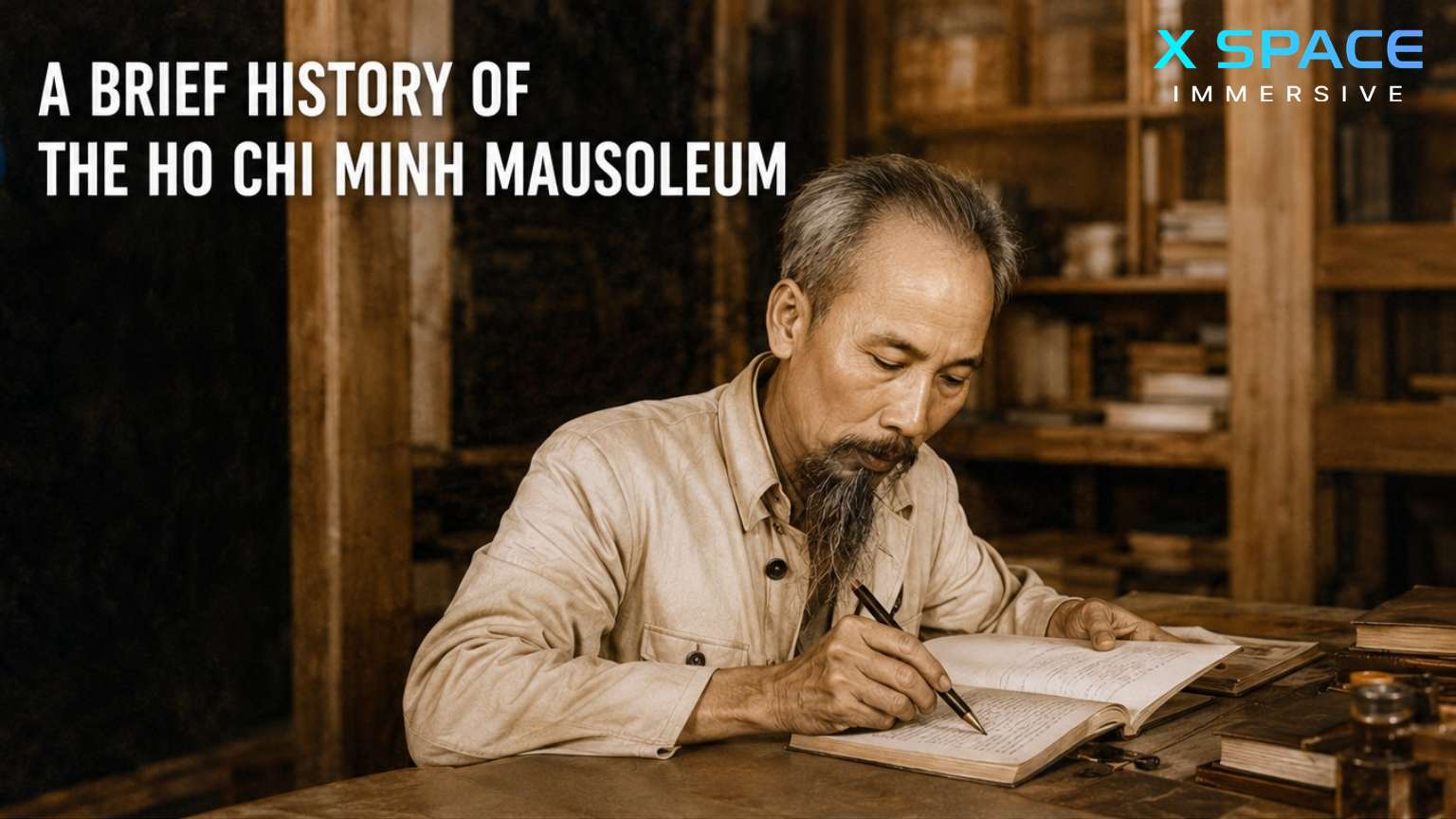
Historical illustration of Ho Chi Minh and the history of the Ho Chi Minh Mausoleum
Understanding the history behind the site can make your visit much more meaningful.
President Ho Chi Minh died in Hanoi in 1969. Following his death, the Vietnamese authorities decided to build a permanent memorial where people could pay their respects.
Construction of the mausoleum began in 1973, and the building was formally inaugurated in August 1975. Its monumental design was influenced by other state mausoleums, particularly Lenin’s Mausoleum in Moscow, while also incorporating Vietnamese architectural and symbolic elements.
The exterior is built from gray granite, giving the structure a solid and dignified appearance. The words “Chủ tịch Hồ Chí Minh,” meaning “President Ho Chi Minh,” are displayed prominently above the entrance.
The gardens surrounding the building contain plants and flowers associated with different regions of Vietnam. Rows of bamboo, carefully maintained lawns and formal pathways add Vietnamese character to the monumental setting.
Who Was President Ho Chi Minh?
Ho Chi Minh was a Vietnamese revolutionary leader and a central figure in the country’s struggle for independence during the twentieth century.
Born Nguyen Sinh Cung in 1890, he spent many years living and working abroad before returning to Vietnam. His political activities became closely connected with the movement for Vietnamese independence and the establishment of the Democratic Republic of Vietnam in 1945.
For travelers, the mausoleum complex offers only an introduction to his long and complex life. To gain a fuller understanding, consider visiting the nearby museum, where photographs, documents, personal objects and themed exhibitions place his biography within a broader historical context.
When and Why Was the Mausoleum Built?
The mausoleum was created as a national memorial and a place where future generations could remember President Ho Chi Minh’s life and political legacy.
Although Ho Chi Minh reportedly expressed a preference for cremation, the decision was made to preserve his body and build the memorial in Ba Dinh Square.
The site was especially significant because of its connection to the declaration of independence in 1945. As a result, the location links Ho Chi Minh’s personal history with one of the defining events in modern Vietnam.
Today, the mausoleum remains one of the most recognizable examples of a national mausoleum Vietnam visitors can enter. Its significance comes not only from the person memorialized inside but also from its position within the ceremonial landscape of Ba Dinh Square.
Ho Chi Minh Mausoleum Opening Hours and Opening Times
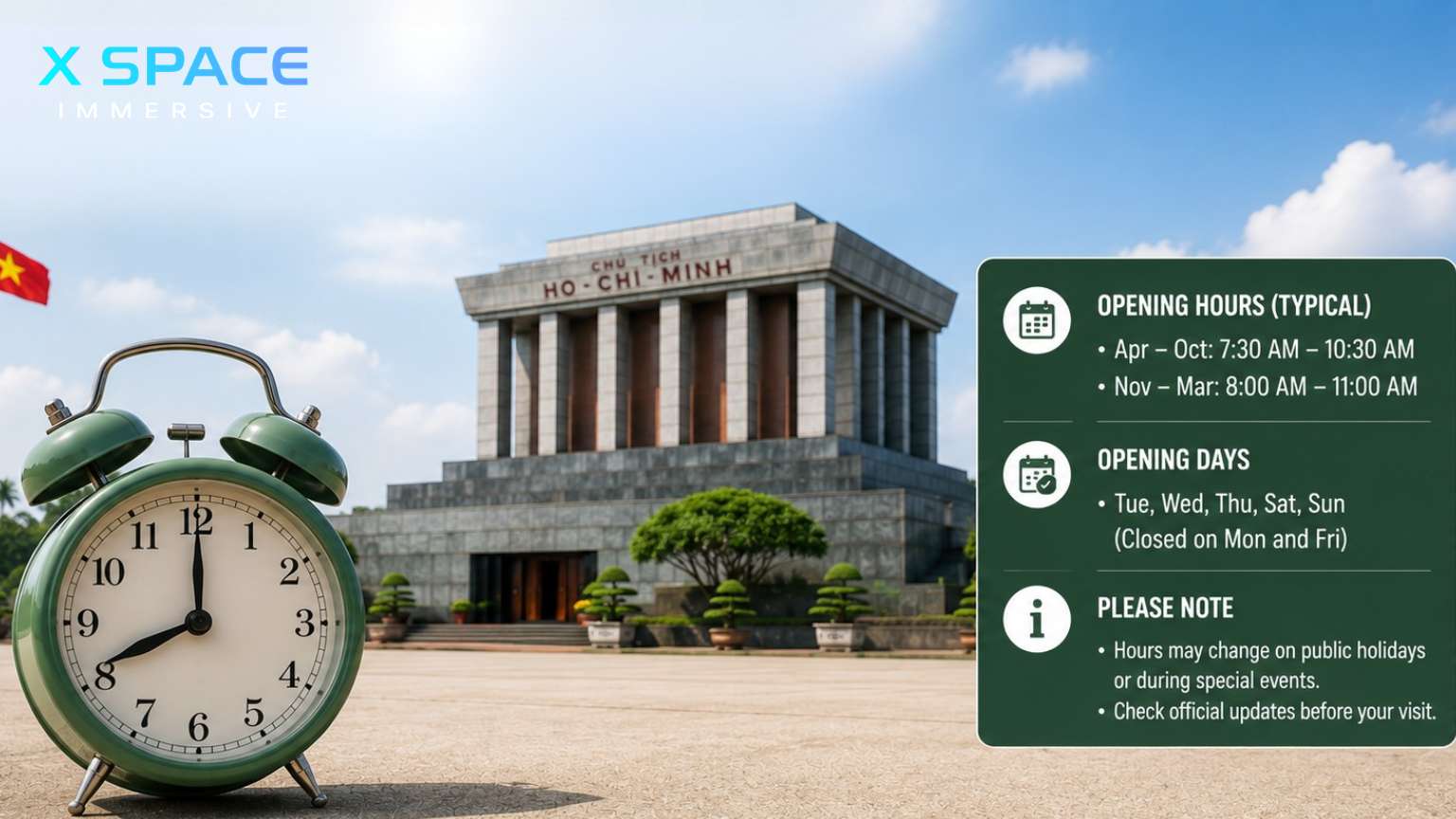
Ho Chi Minh Mausoleum opening hours and opening times visitor information
One of the most important things to understand is that the mausoleum does not normally operate like a full-day tourist attraction.
Visits are generally organized during selected mornings of the week, and opening schedules may differ between warmer and cooler seasons.
Commonly published Ho Chi Minh Mausoleum opening hours are:
- From approximately April through October: 7:30 a.m. to 10:30 a.m.
- From approximately November through March: 8:00 a.m. to 11:00 a.m.
- Regular visiting days are usually Tuesday, Wednesday, Thursday, Saturday and Sunday.
- The mausoleum is generally closed on Monday and Friday.
Weekend and public-holiday sessions may sometimes continue slightly longer. Special arrangements may also be made on important national dates.
These schedules should be treated as planning guidance rather than a permanent guarantee. Official ceremonies, annual preservation work, public holidays, weather conditions or operational requirements may affect access.
Current Ho Chi Minh Mausoleum Opening Hours
Before leaving your accommodation, confirm the current Ho Chi Minh Mausoleum opening hours through an official local source, your hotel, a reputable tour operator or the management authority’s latest announcement.
Do not rely only on an old blog post or a map listing. Many visitors arrive after the morning session has ended because they assume the mausoleum remains open throughout the afternoon.
If the mausoleum is an essential part of your trip, schedule it early in your Hanoi itinerary. This gives you another opportunity to return if your original visit is affected by a temporary closure.
Best Time of Day to Visit
Arriving early is usually the best strategy.
At weekends, on public holidays and during major Vietnamese anniversaries, the line can become very long. School groups and domestic tour groups may also arrive in the morning.
Reaching the entrance near opening time offers several advantages:
- The weather is usually cooler.
- Waiting times may be shorter.
- You will have more time to explore the surrounding complex.
- You are less likely to miss the final admission period.
Hanoi can become hot and humid during the warmer months. Even though your time inside the mausoleum will be short, parts of the queuing process may take place outdoors.
Annual Maintenance and Temporary Closures
The mausoleum may close for annual preservation and maintenance work. These temporary closures can last for an extended period and may occur around similar months each year, but the exact dates are announced separately.
The Ho Chi Minh Mausoleum opening times may also change during national events or official ceremonies in Ba Dinh Square.
Always verify the schedule close to your intended travel date, particularly when visiting in the autumn or during major public holidays.
How to Get to Ho Chi Minh Mausoleum Hanoi Vietnam
The mausoleum is centrally located and relatively easy to reach from most popular areas of Hanoi.
However, traffic around Ba Dinh Square can be controlled or redirected, especially during official events. Your driver may need to leave you a short walk from the visitor entrance.
Getting There by Taxi or Ride-Hailing App
A taxi or ride-hailing app is the simplest option for most first-time visitors.
Enter “Ho Chi Minh Mausoleum,” “Ba Dinh Square” or the official visitor entrance listed in the latest local information. Showing the Vietnamese name “Lăng Chủ tịch Hồ Chí Minh” can also help.
Ask the driver to take you to the visitor entrance rather than simply stopping in front of the square. Security barriers and controlled roads can make the most obvious drop-off point inconvenient.
Use a metered taxi from a reputable company or confirm the fare through your ride-hailing application before departure.
Getting There by Public Bus
Public buses serve the Ba Dinh area and can be an affordable way to reach the complex.
Routes and stops may change over time, so check a current Hanoi transport application or ask your accommodation for the most suitable route from your location.
After leaving the bus, expect to walk several minutes to the security area. Give yourself extra time so that a delayed bus does not cause you to miss the limited morning visiting period.
Walking from Hanoi’s Old Quarter
Travelers who enjoy walking can reach the mausoleum from parts of the Old Quarter in approximately 30 to 45 minutes, depending on their starting point and pace.
The walk allows you to see a quieter side of central Hanoi, but pavements may be uneven or crowded with parked motorbikes. Crossing major roads can also feel challenging for first-time visitors.
Start early, wear comfortable shoes and use a reliable navigation application. During hot weather, taking a taxi to the mausoleum and walking back through the city may be more comfortable.
Parking Information
Visitors arriving by motorbike or private car should use an authorized parking area near the complex.
Do not assume you can park beside Ba Dinh Square. Many streets around government buildings have restrictions, and vehicles left in unauthorized areas may be moved.
Follow local signs, security staff and parking attendants. Keep your ticket safe until you collect your vehicle.
Entrance Fees, Security Checks and Visitor Rules
Security at the mausoleum is more formal than at many other Hanoi attractions.
You may need to pass through a screening area, place belongings through a scanner and leave restricted items at a designated storage point.
Admission arrangements have occasionally been described differently by travel sources, particularly for foreign visitors. For that reason, check current official information rather than relying on an outdated entrance-fee claim.
Security Procedures Before Entering
Bring only what you need.
Large bags can slow down the security process, while cameras and recording devices may need to be stored before entering certain areas. Food and drinks may also be restricted.
Keep your passport or a copy of your identification available, although requirements can depend on current procedures.
Listen carefully to guards and staff. Even when instructions are not explained in detail in English, signs and gestures generally make the process easy to follow.
Dress Code and Respectful Behavior
Visitors should dress modestly.
Avoid very short shorts, miniskirts, sleeveless tops and clothing that exposes the shoulders or chest. A light shirt, blouse, long dress or trousers is a safer choice.
Inside the mausoleum:
- Remove hats and sunglasses when instructed.
- Keep your hands out of your pockets.
- Do not talk loudly.
- Do not eat, drink or chew gum.
- Walk continuously with the line.
- Do not touch barriers or displays.
- Follow the instructions of the honor guard.
These expectations are not designed to make visitors uncomfortable. They reflect the ceremonial and memorial nature of the mausoleum of Ho Chi Minh.
Photography and Mobile Phone Rules
Photography and filming are generally restricted inside the mausoleum.
You may be asked to turn off your phone or leave cameras and recording equipment at a storage counter before entering. Photography is normally possible in approved outdoor areas, but temporary restrictions may apply.
Never assume that a photograph is allowed simply because another visitor is taking one. Observe official signs and follow instructions from staff.
Ba Dinh Square and the mausoleum exterior can provide impressive photographs, especially early in the morning, but avoid playful or disrespectful poses directly in front of the memorial.
What to Expect During Your Visit
A typical visit begins at a security checkpoint, where visitors form an organized queue.
After screening, the line follows a controlled route toward the mausoleum. Depending on the day, the queue may move quickly or extend through a large waiting area.
The atmosphere becomes quieter as you approach the entrance. Guards maintain order, and visitors are expected to walk in pairs or in a close line.
Queuing and Entry Process
On a quiet weekday, the process may be relatively quick. At weekends or on special dates, waiting can take considerably longer.
Shade may be limited in parts of the line, so prepare for the weather. A small umbrella may be useful outside, but you may be required to close or store it before entering.
Families traveling with young children should explain the need for silence in advance. Elderly visitors and travelers with limited mobility may wish to ask staff about available assistance.
Inside the Mausoleum of Ho Chi Minh
The interior is cool, dimly lit and highly controlled.
Visitors pass through the central chamber in silence. President Ho Chi Minh’s body rests inside a glass case, with uniformed guards positioned nearby. The route does not allow visitors to stop for an extended period.
The experience may last only a few minutes, yet many people find it memorable because of the contrast between the large public square outside and the intimate silence of the memorial chamber.
Whatever your personal understanding of Vietnamese history, approach the experience with cultural sensitivity. For the people around you, the visit may carry deep emotional meaning.
How Long Does a Visit Take?
The time inside the building is brief, but the entire process can take anywhere from around 30 minutes to more than an hour, depending on the queue and security checks.
Allow at least two to three hours if you plan to explore the entire complex, including the Presidential Palace grounds, Ho Chi Minh’s Stilt House, the One Pillar Pagoda and the museum.
A slower half-day visit is ideal for travelers who enjoy history and want time to read the exhibitions rather than simply photograph the main landmarks.
Top Attractions Near the Ho Chi Minh Mausoleum
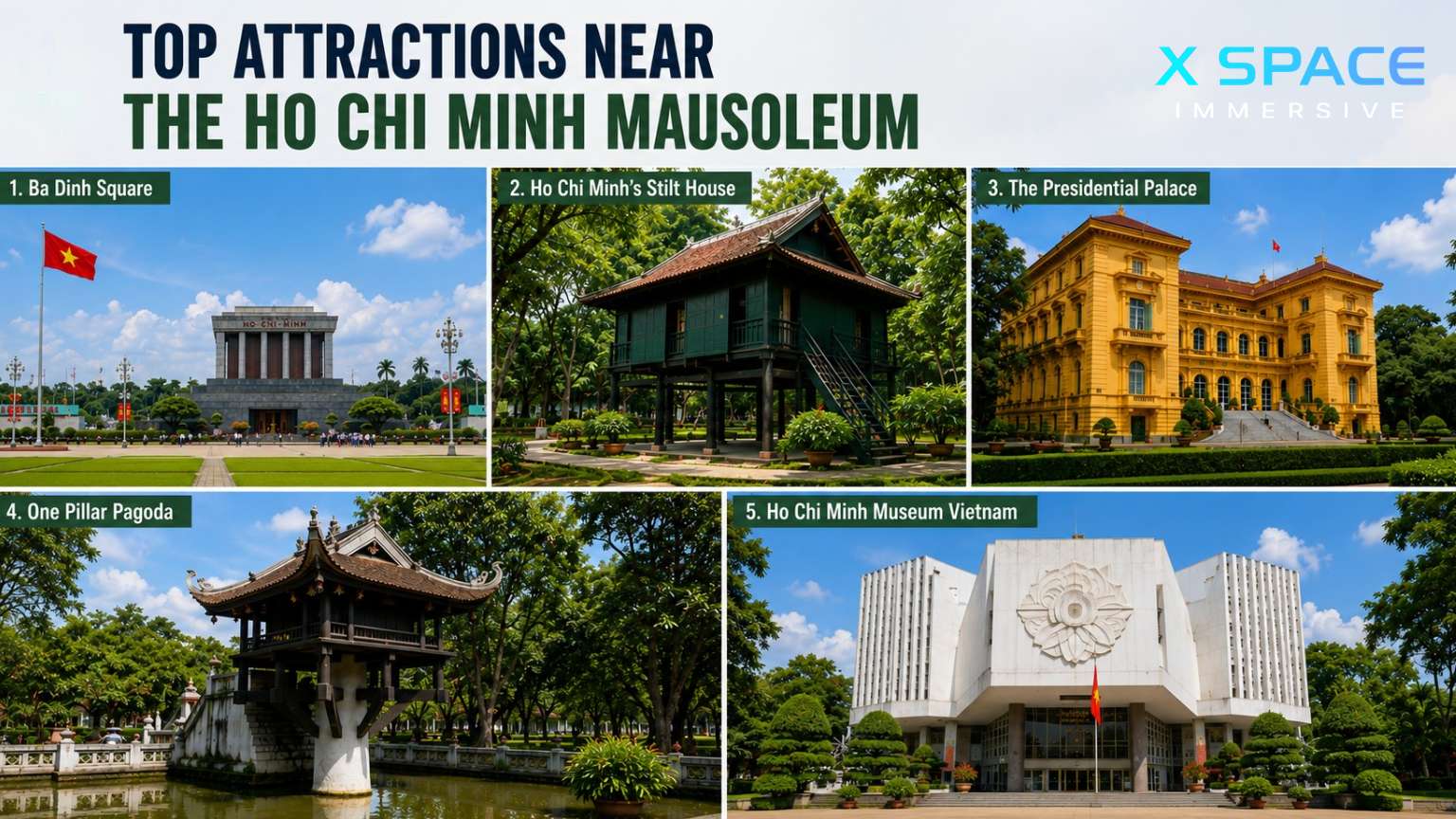
Top attractions near Ho Chi Minh Mausoleum including One Pillar Pagoda and Ho Chi Minh Museum Vietnam
The surrounding area contains several important attractions within walking distance.
Instead of leaving immediately after your mausoleum visit, continue through the complex to gain a richer understanding of Ho Chi Minh’s life and the history of modern Vietnam.
Ba Dinh Square
Ba Dinh Square stretches directly in front of the mausoleum.
The broad ceremonial space is divided by neat lawns and pathways. It is used for national events, official gatherings and daily flag ceremonies.
The square feels particularly atmospheric early in the morning, when the light is soft and the city has not yet reached its busiest rhythm.
Remain within designated visitor areas. Access may be restricted during rehearsals, ceremonies or official events.
Ho Chi Minh’s Stilt House
Behind the Presidential Palace is a modest wooden stilt house associated with Ho Chi Minh’s years as president.
The building is surrounded by trees and a peaceful pond, creating a striking contrast with the grand colonial architecture nearby. Its simple rooms and furnishings are often presented as symbols of Ho Chi Minh’s modest lifestyle.
Visitors usually view the house from an external walkway rather than entering the rooms.
The Presidential Palace
The Presidential Palace was constructed during the French colonial period and is recognized by its yellow façade and European architectural style.
Ho Chi Minh did not live in the palace itself. Instead, he used other buildings in the grounds, including a simpler residence and the stilt house.
Public access is generally limited to selected outdoor routes and surrounding gardens. The building remains a government-related site, so some areas are not open to tourists.
One Pillar Pagoda
The One Pillar Pagoda is one of Hanoi’s best-known religious landmarks.
Its distinctive structure appears to rise from a single stone pillar above a lotus pond. Although the present building has been reconstructed, the pagoda’s origins date back to the Ly Dynasty.
The site is small and can become crowded, but it is easy to include in a walking route through the mausoleum complex.
Dress respectfully and avoid blocking worshippers while taking photographs.
Ho Chi Minh Museum Vietnam
The Ho Chi Minh Museum Vietnam offers the most detailed interpretation of Ho Chi Minh’s life, political activities and historical period.
The permanent exhibition combines documents, photographs, artifacts, symbolic installations and multimedia displays. The official museum describes its exhibition as covering Ho Chi Minh’s biography, Vietnam’s revolutionary history and major international events that influenced his era.
The museum building was designed in the form of a white lotus and was inaugurated on May 19, 1990.
According to the museum’s current official website, regular opening sessions are listed from 8:00 a.m. to 12:00 p.m. and from 2:00 p.m. to 4:30 p.m. on Tuesday, Wednesday, Thursday, Saturday and Sunday, with closure on Monday and Friday. Always verify holiday changes before visiting.
The museum and mausoleum serve different purposes. The mausoleum is primarily a solemn memorial, while the museum provides historical explanation and educational context.
Essential Tips for Visiting Ho Chi Minh Mausoleum
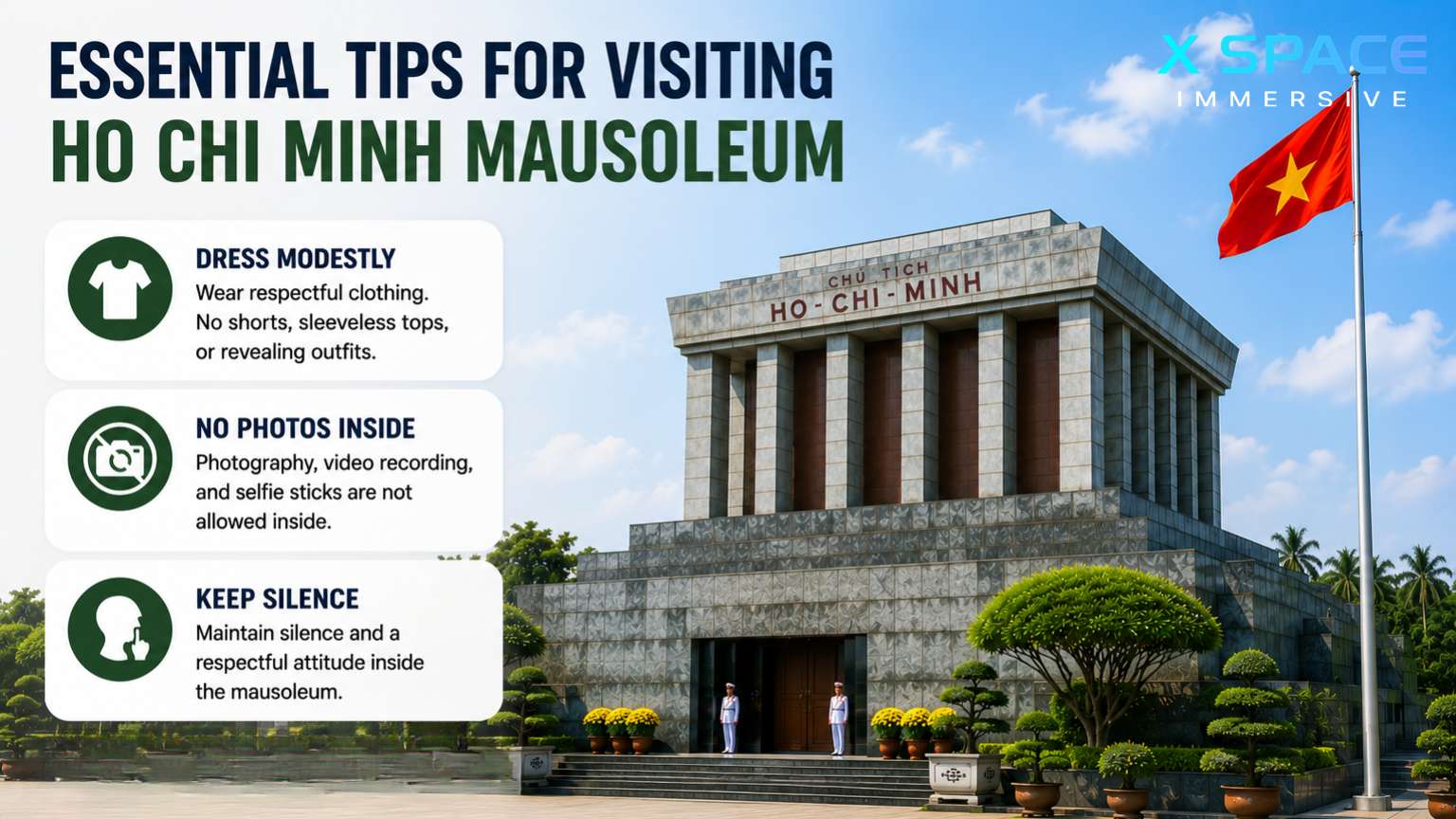
Essential tips for visiting Ho Chi Minh Mausoleum including dress code and visitor rules
A little preparation can make the experience much smoother.
Arrive Early
Try to arrive before or near the beginning of the visiting session.
Early arrival helps you avoid the hottest part of the morning and gives you enough time to continue through the surrounding attractions.
Do not plan a tightly scheduled activity immediately afterward. Queues and security procedures can be unpredictable.
Bring Only Essential Items
Carry a small bag with basic necessities.
Avoid bringing professional photography equipment, large backpacks, food packages or unnecessary electronics. The fewer items you carry, the easier the security process will be.
Keep valuables with you unless staff direct you to use an official storage facility.
Check the Weather Forecast
Much of the complex is outdoors.
During summer, Hanoi can be hot, humid and sunny. During winter, mornings may feel cool, damp or misty.
Wear comfortable walking shoes and bring weather-appropriate clothing. Sunscreen can be helpful, but apply it before entering the queue to avoid handling bottles during security screening.
Plan Enough Time for the Entire Complex
The mausoleum is only one part of the experience.
A rushed visitor may see the memorial and leave within an hour. A curious traveler can easily spend half a day exploring the square, gardens, historical residences, pagoda and museum.
Planning a relaxed morning allows the story of the area to unfold naturally.
Respect Local Customs
Follow the behavior of local visitors.
Stand quietly, move with the line and avoid treating the memorial as a background for casual social-media content. A respectful attitude will make your visit more meaningful and help you connect with the cultural importance of the site.
Suggested Ho Chi Minh Mausoleum Itinerary
One-Hour Express Visit
For a short visit:
- Arrive at the security entrance before opening.
- Join the queue for the mausoleum.
- Walk through the memorial hall.
- Spend a few minutes viewing Ba Dinh Square.
- Take exterior photographs from an approved area.
This option works for travelers with limited time, but it does not provide much historical context.
Half-Day Historical Tour
For a more complete experience:
- Visit the President Ho Chi Minh Mausoleum early in the morning.
- Walk through the Presidential Palace grounds.
- See Ho Chi Minh’s Stilt House.
- Stop at the One Pillar Pagoda.
- Visit the Ho Chi Minh Museum Vietnam.
- Have lunch in Ba Dinh or return to the Old Quarter.
This route creates a more coherent story, moving from national memory to personal history and museum interpretation.
Full-Day Hanoi Cultural Experience
Begin with the mausoleum complex in the morning.
After lunch, continue to another major historical attraction such as the Imperial Citadel of Thang Long, the Temple of Literature or Hoa Lo Prison Relic.
In the evening, balance the historical side of Hanoi with a contemporary cultural experience. A digital-art venue, theater performance or immersive exhibition can reveal how the city continues to reinterpret storytelling through new technology.
Frequently Asked Questions About Ho Chi Minh Mausoleum
Is Ho Chi Minh Mausoleum Open Every Day?
No. Regular public visits are generally held on selected mornings, commonly Tuesday, Wednesday, Thursday, Saturday and Sunday.
Monday and Friday are usually closed days, although exceptions may apply on important national occasions. Check an updated official announcement before traveling.
What Are the Ho Chi Minh Mausoleum Opening Times?
The commonly published seasonal schedule is approximately 7:30 a.m. to 10:30 a.m. during warmer months and 8:00 a.m. to 11:00 a.m. during cooler months.
Weekend or holiday sessions may occasionally be extended. Temporary maintenance periods can also affect the Ho Chi Minh Mausoleum opening times.
Can Visitors Take Photos Inside?
No photography or filming should be expected inside the central memorial hall.
Cameras or recording devices may need to be stored before entry. Outdoor photography is permitted only in approved areas and may be restricted during official events.
Is There a Dress Code?
Yes. Wear modest clothing that covers your shoulders and extends to around the knees or lower.
Avoid sleeveless tops, very short shorts, revealing dresses and clothing with inappropriate words or images.
How Long Should I Spend at the Complex?
Allow at least 30 to 60 minutes for the mausoleum process alone.
For the full complex, two to four hours is more comfortable. History enthusiasts may wish to spend additional time inside the museum.
Is the Mausoleum Suitable for Children and Elderly Visitors?
Yes, but prepare for walking, waiting and warm weather.
Children should be able to remain quiet and follow instructions inside. Elderly visitors or people with mobility concerns can ask staff about assistance, although accessibility conditions may vary between different parts of the complex.
Experience X Space Immersive

Visitors enjoying immersive digital art experience at X Space Hanoi
After a thoughtful morning exploring Hanoi’s history, X Space Immersive offers a completely different way to experience the city.
Instead of historical artifacts and ceremonial architecture, this contemporary attraction surrounds visitors with large-scale projections, digital imagery, lighting effects, sound and interactive installations. The venue presents itself as an immersive digital-art experience where technology and imagination come together.
This contrast can make your Hanoi itinerary feel more balanced. The morning invites reflection on Vietnam’s past, while the afternoon or evening introduces a playful, visual and technology-driven side of the capital.
Continue Your Hanoi Journey Through an Immersive Experience
At X Space Immersive, visitors do not simply stand in front of traditional framed artworks.
Digital scenes move across walls and floors, surrounding the audience with changing colors, atmospheric sound and responsive visual effects. Some areas encourage interaction, while others create dreamlike environments designed for observation and photography.
The experience can appeal to families, couples, groups of friends and international travelers searching for an indoor activity after a long morning outdoors.
It is also a practical option during very hot or rainy weather.
Why Add X Space Immersive to Your Hanoi Itinerary?
The Ho Chi Minh Mausoleum Hanoi Vietnam introduces visitors to the capital through history, memory and national identity.
X Space Immersive reveals another side of the city: youthful, creative and willing to experiment with new forms of art and storytelling.
Visiting both in one day creates an interesting journey between two very different spaces. One is quiet, ceremonial and rooted in modern history. The other is colorful, interactive and focused on sensory exploration.
Together, they show that Hanoi is not limited to a single image. It is a city where tradition and technology can exist side by side.
Plan Your X Space Immersive Visit
X Space Immersive is located inside Vincom Mega Mall Royal City at 72A Nguyen Trai Street in Hanoi.
The venue’s official website currently lists the following hours:
- Monday to Friday: 10:00 a.m. to 10:00 p.m.
- Saturday, Sunday and public holidays: 9:30 a.m. to 10:00 p.m.
Opening hours, ticket categories and exhibition content may change, so check the official booking information before visiting.
From the mausoleum area, you can travel to Royal City by taxi or ride-hailing service. The journey time depends heavily on Hanoi traffic, so avoid scheduling your ticket too close to the end of your historical tour.
Allow time for lunch, transportation and a short rest between the two experiences.
After walking through one of Vietnam’s most meaningful historical landmarks, stepping into a world of digital light and sound can be a memorable way to complete your day.
Discover X Space Immersive and experience Hanoi from an entirely new perspective.
Conclusion
A visit to the Ho Chi Minh Mausoleum is more than a stop on your Hanoi itinerary—it is an opportunity to better understand Vietnam’s rich history and cultural heritage. By planning your visit in advance and following local guidelines, you can enjoy a respectful and memorable experience. After exploring this historic landmark, consider continuing your journey with modern attractions like X Space Immersive to discover another fascinating side of Hanoi.
Was this article helpful?
Thanks for your feedback!